
In this article
- Detection Tells You Something Changed. Diagnosis Tells You What.
- Prognostics Adds the Question Autonomy Really Needs
- The Critical Step Is Turning Prediction Into Action
- Knowing You Are Weak Is Different From Being Broken
- Uncertainty Has to Travel With the Prediction
- From Individual Health to Collective Decisions
- Predictive Health Is Not the Same as Self-Awareness
- The Machine Should Change Its Mind Before It Breaks
An autonomous aircraft is halfway through a mission when its electrical system begins behaving differently.
Nothing has failed outright. The aircraft is still flying. Its navigation system works. Its sensors are online.
But something is changing.
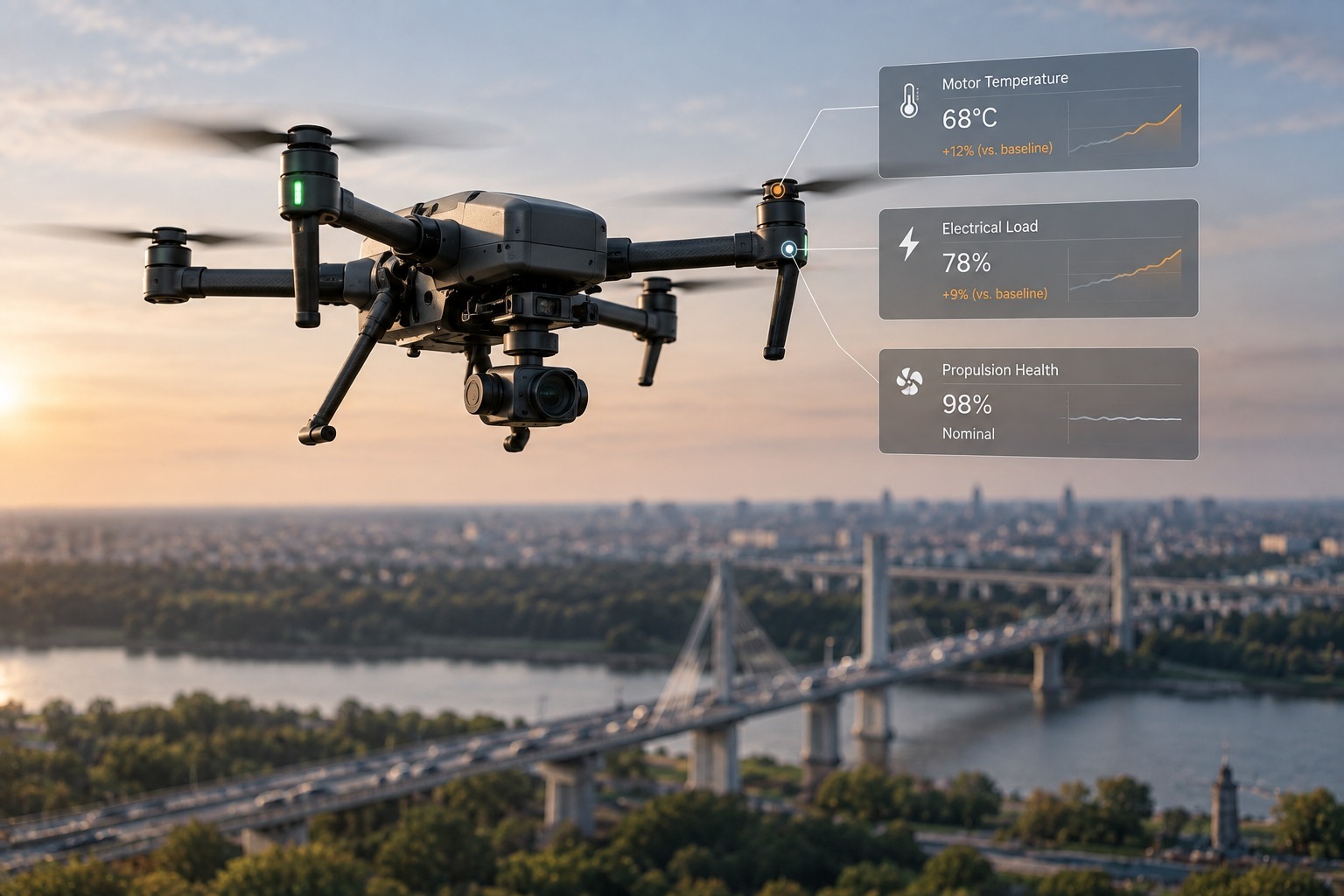
A conventional monitoring system might continue operating until a measurement crosses a predefined threshold. A more capable autonomous system can ask harder questions: What is causing the change? How quickly is it progressing? What does it mean for the rest of the mission?
That is where diagnostics and prognostics begin to change autonomy.
At AstraQua Inc, this distinction is central to thinking about Physical AI. Autonomous systems should not only recognize failures. They need enough understanding of their changing condition to make better decisions before failure dictates the outcome.
Detection Tells You Something Changed. Diagnosis Tells You What.
Health monitoring begins with observation.
A system may notice an unexpected temperature trend, abnormal current draw, unusual vibration, degraded sensor behavior, or another departure from its expected operating state.
But detecting an anomaly does not explain it.
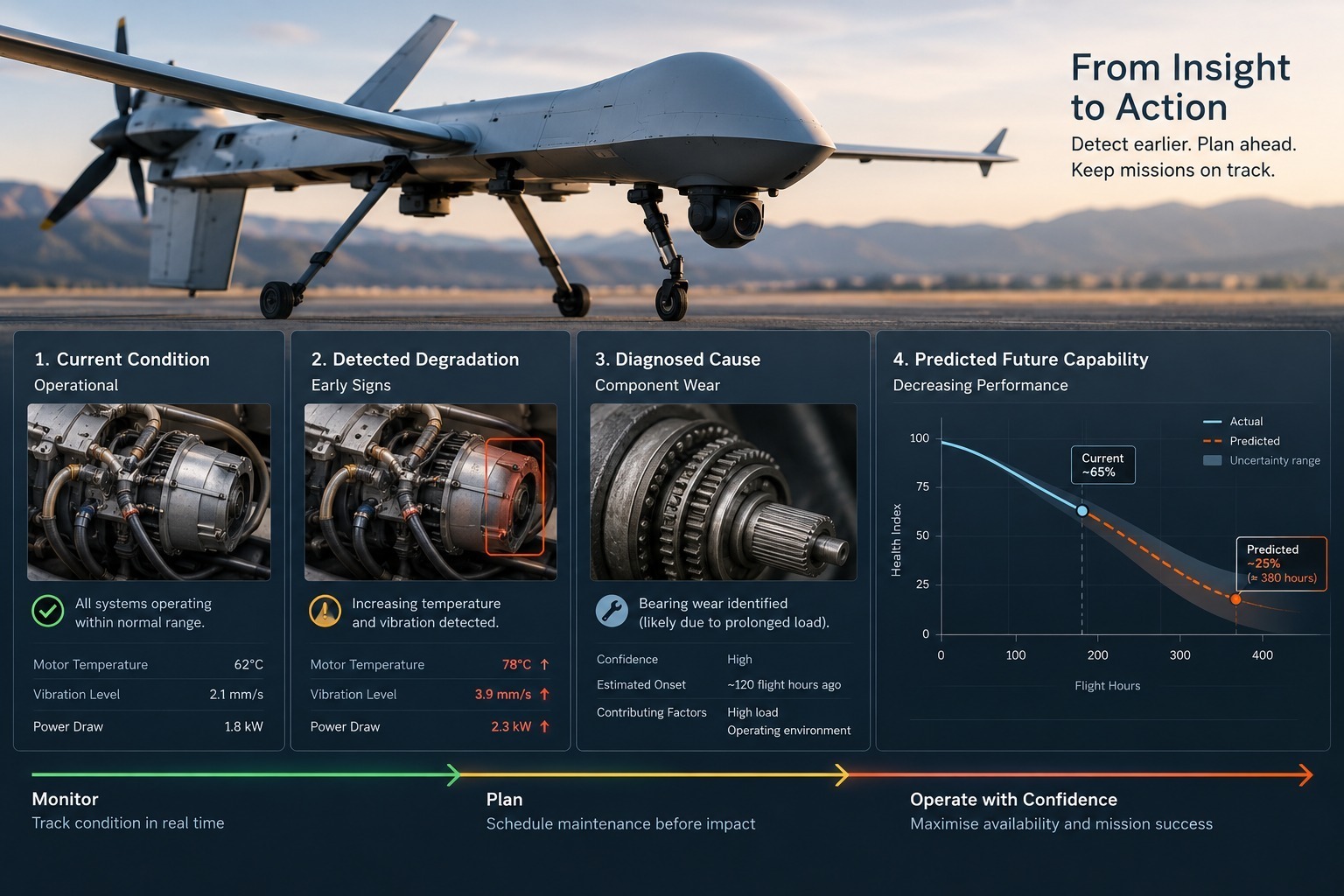
Diagnostics attempts to identify and isolate the underlying fault or degradation. Instead of simply reporting that a measurement looks unusual, diagnostic reasoning asks which component or condition best explains the available evidence.
NASA’s Diagnostics & Prognostics Group describes fault detection and diagnostics alongside physics-based, data-driven, and hybrid approaches to understanding system health. Its work spans aircraft, batteries, powertrains, spacecraft, UAVs, and other systems.
For autonomy, this matters because different causes require different responses.
A temporary temperature spike may be manageable. A pattern consistent with progressive component degradation may justify changing the mission immediately.
The machine needs to know the difference.
Prognostics Adds the Question Autonomy Really Needs
Diagnosis focuses on the current condition.
Prognostics looks forward.
NASA defines prognostics around predicting when a component will no longer perform its intended function, producing estimates such as remaining useful life. Importantly, that prediction needs to happen early enough for the system or operator to prevent the developing problem from becoming critical.
For an autonomous machine, however, the most useful question is often broader than “How long until failure?”
It is:
How long can I continue doing what the mission currently requires?
Remaining capability depends on future workload and operating conditions.
A machine might have hours of theoretical component life remaining under light operation but far less usable margin under a demanding mission. Prognostics therefore becomes more valuable when it considers future health alongside what the machine intends to do next.
That converts a maintenance prediction into operational intelligence.
The Critical Step Is Turning Prediction Into Action
Imagine an autonomous system determines that a subsystem is degrading.
Diagnosis indicates the likely problem. Prognostics estimates that the condition will probably remain acceptable for another 40 minutes under the current operating profile.
The mission requires another 55 minutes.
That gap is where autonomy changes.
The machine could shorten the mission, reduce workload, alter its route, preserve resources, transfer a task to another system, or move toward a safe recovery state.
NASA research on prognostics-enhanced automated contingency management has explored this exact connection between health information and action. The approach combines current health estimates from diagnosis with future health estimates from prognosis so systems can support fault mitigation, control changes, mission replanning, and resource redistribution.
In other words, prognostics becomes useful to autonomy when the forecast can change the plan.
Knowing You Are Weak Is Different From Being Broken
This distinction sounds simple, but it represents a major change in how machines operate.
A binary system thinks in states:
healthy / failed
A health-aware autonomous system can reason across a continuum:
healthy → degrading → capability constrained → mission limiting → failed
The middle of that sequence is where many of the most valuable decisions exist.
If the machine recognizes degradation while meaningful capability remains, it has options. Once the system reaches failure, those options may disappear.
NASA’s work on autonomous UAS health management has similarly investigated architectures where onboard monitoring continuously supplies system-health information and automated reasoning uses that information to develop contingency plans when failures occur.
The objective is not to make machines obsessed with their own condition. It is to make health information relevant to what they do next.
Uncertainty Has to Travel With the Prediction
A prognosis is not a countdown clock.
Physical systems operate amid changing loads, environmental conditions, measurement noise, incomplete information, and uncertain degradation rates.
A system might estimate that a component has 40 minutes of useful operation remaining, but the uncertainty around that estimate could be significant.
That uncertainty should affect behavior.
NASA’s current diagnostics and prognostics research explicitly includes identifying, quantifying, propagating, and representing uncertainty, as well as health-informed decision-making under uncertainty.
An autonomous system with a highly certain health estimate might continue its mission confidently. The same predicted remaining capability with high uncertainty may justify a more conservative decision.
Reliable autonomy therefore requires more than predicting the future.
It requires knowing how much confidence to place in that prediction.
From Individual Health to Collective Decisions
The implications become larger when autonomous systems operate as a mission community.
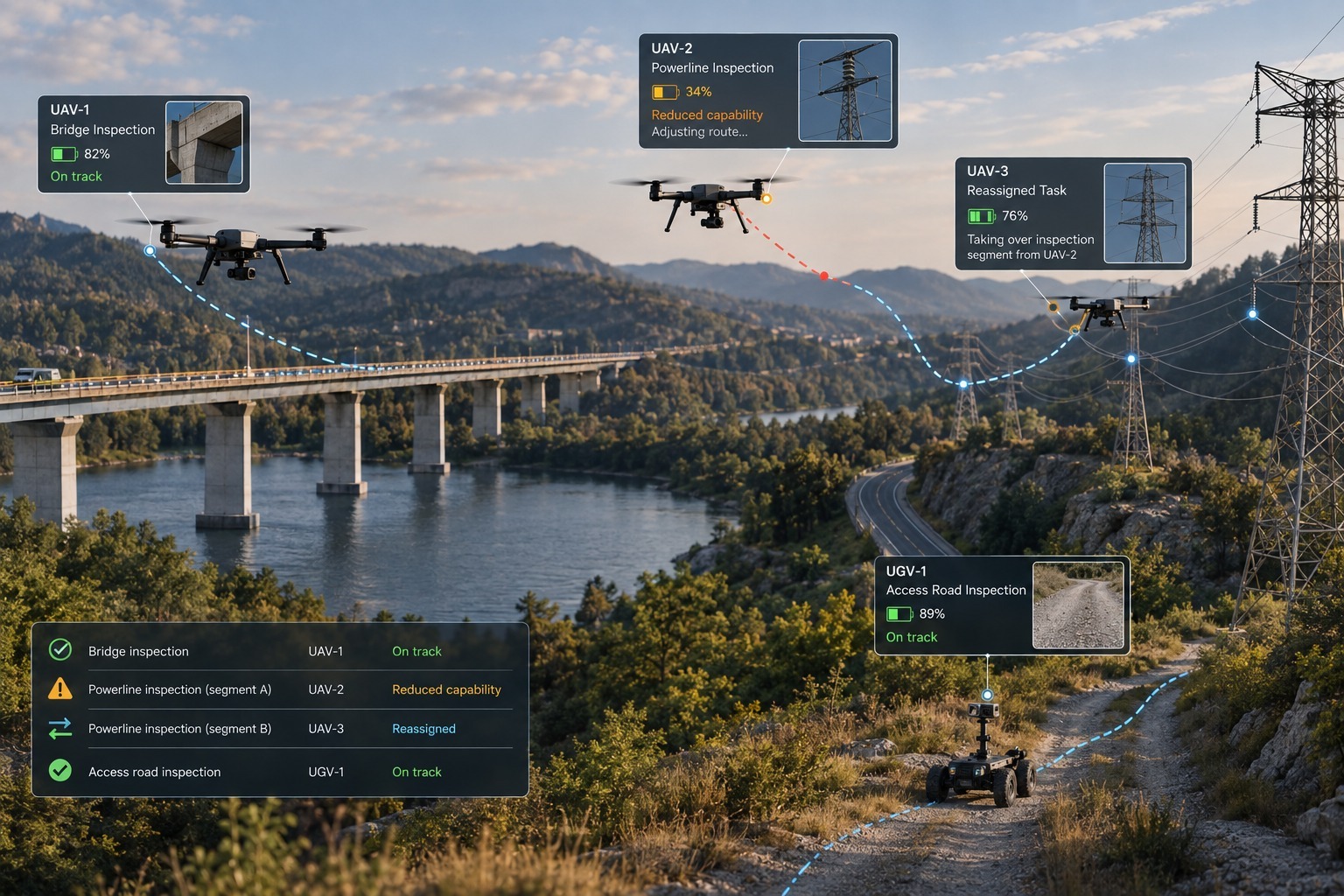
Suppose four machines are performing an inspection. One diagnoses developing degradation and forecasts reduced capability.
The mission does not necessarily need to stop.
If that health information becomes part of collective decision-making, another machine could assume the most demanding task while the degrading system completes a shorter assignment or moves toward recovery.
NASA’s Prognostics Center of Excellence identifies this post-prognostic reasoning as a key challenge: converting prognostic information into action while accounting for mission requirements, logistics, and fleet management.
This is where diagnostics and prognostics move beyond maintenance.
They become inputs to distributed autonomy.
Predictive Health Is Not the Same as Self-Awareness
This distinction also connects this topic to the broader idea of operational self-awareness.
Diagnostics can tell a machine what is wrong.
Prognostics can estimate where that condition is heading.
Operational self-awareness is broader. It combines health information with sensor trustworthiness, available energy, compute resources, connectivity, uncertainty, environmental conditions, and mission readiness.
A machine could be mechanically healthy but still lack the sensing confidence or energy required for a particular task.
Predictive health is therefore one important source of internal knowledge, not the entire autonomous decision process.
NASA has argued that system health management and autonomy become more powerful when capabilities such as anomaly detection, diagnostics, and prognostics are integrated with planning, scheduling, and mission execution rather than treated as separate functions.
That integration is the important shift.
The Machine Should Change Its Mind Before It Breaks
The defining moment for intelligent autonomy is not when a machine reports failure.
It is earlier.
It is the moment the system recognizes that its condition is changing, understands what that change probably means, evaluates how its future capability affects the mission, and chooses a different course while meaningful options remain.
That is how diagnostics and prognostics change autonomy.
They turn machine health from a maintenance signal into a decision variable.
For Physical AI, the next step is therefore not simply building machines that can execute increasingly sophisticated plans. It is building health-aware autonomous systems that know when the assumptions behind those plans are no longer true and can change their minds before weakness becomes failure.
Explore AstraQua’s work in Physical AI and health-aware autonomous systems at AstraQua.com.
Explore the related solution: Operational Self-Awareness with AstraSense.