
In this article
- From Periodic Inspection to Persistent Awareness
- A Bridge Does Not Need Another Folder of Images
- Roads Can Become Continuously Observable
- Utilities Require Autonomy Beyond the Road Network
- After a Disaster, Inspection Speed Changes Meaning
- Fleet-Scale Autonomy Changes the Economics of Inspection
- Infrastructure Still Needs Humans—But Humans Need Better Signals
- The City Becomes a Living Operational Picture
A storm moves through a city overnight.
By morning, a bridge has experienced unusual water flow, debris has accumulated near a drainage system, pavement damage has worsened on a major route, and part of a utility corridor needs closer inspection.
Today, discovering those changes can require separate crews, scheduled inspections, citizen reports, or an obvious failure.
But imagine a different model.
Autonomous systems distributed across the city detect changes, compare them with previous observations, identify which conditions deserve attention, and coordinate follow-up inspections. Human engineers still make critical infrastructure decisions, but they receive better information sooner.
The city has not become conscious. It has developed something more practical: a distributed ability to inspect its own physical condition.
For AstraQua Inc., this represents an important application of Physical AI. The opportunity is not simply deploying more drones or robots. It is giving autonomous systems software the ability to turn distributed machines into a coordinated infrastructure-inspection network.
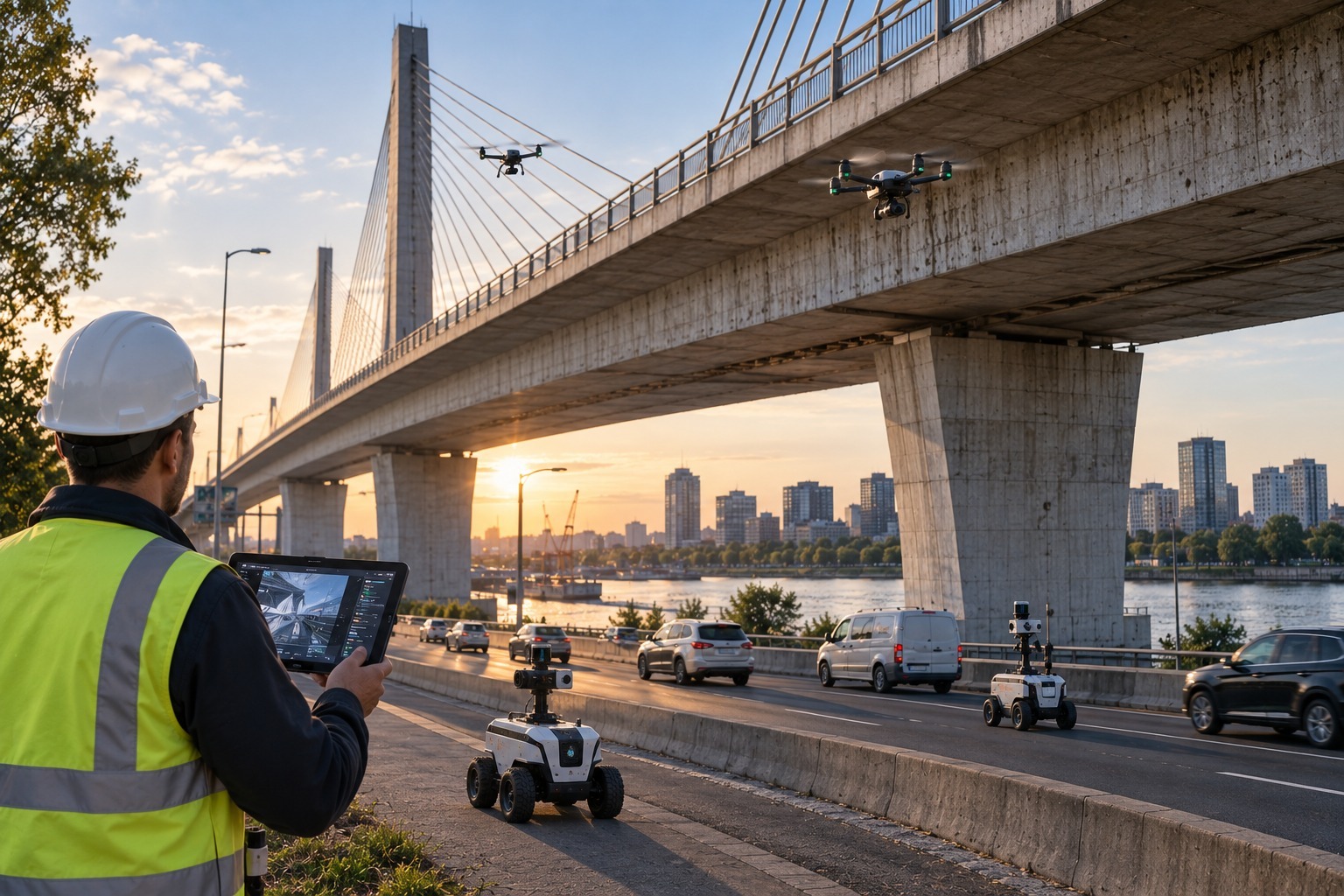
From Periodic Inspection to Persistent Awareness
Public infrastructure is enormous.
Roads stretch for thousands of miles. Bridges contain difficult-to-access structural elements. Utilities extend above and below ground. Drainage systems, retaining structures, rail corridors, power infrastructure, and public facilities all change over time.
Traditional inspection is therefore necessarily selective.
Teams inspect assets according to schedules, regulatory requirements, known problems, and available resources. That process remains essential, particularly where hands-on evaluation and professional engineering judgment are required.
Autonomous systems introduce another layer: persistent observation between those inspection events.
A machine could revisit the same road segment, bridge surface, utility corridor, or drainage channel and ask a simple question:
What changed since last time?
That shift from collecting isolated images to recognizing meaningful change is where AI software becomes particularly useful.
A Bridge Does Not Need Another Folder of Images
Drones are already being investigated and used for inspection.
Federal Highway Administration research found that unmanned aerial systems can support bridge inspection by collecting imagery from difficult-to-access areas and generating large quantities of inspection data. FHWA has also examined how to assess, present, and store that data so it becomes reliable and actionable for infrastructure owners.
The next challenge is not simply collecting more data.
It is deciding what matters.
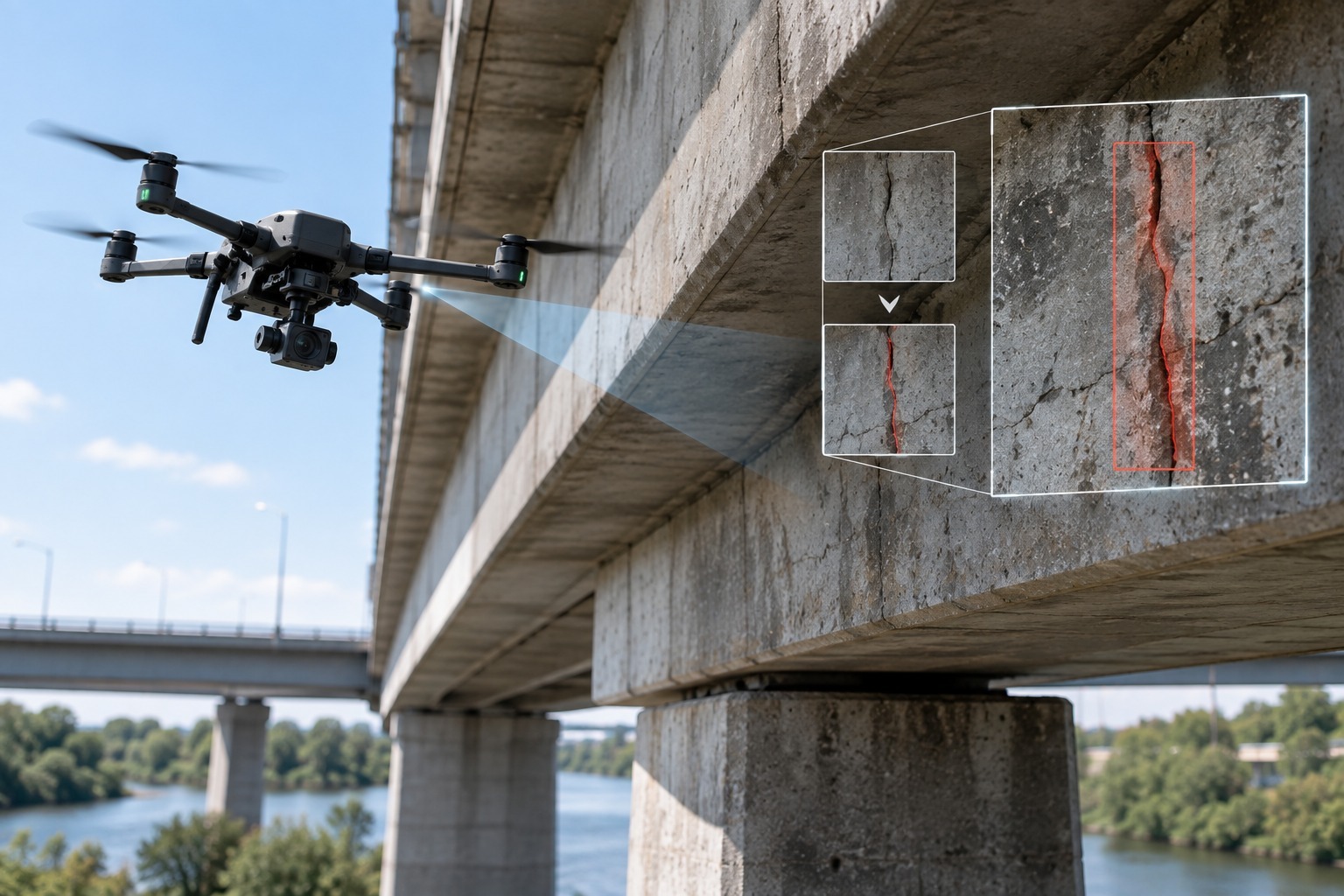
Imagine an autonomous inspection system repeatedly observing the underside of a bridge. Instead of delivering hundreds of unsorted images after every mission, its AI software could compare observations across time and flag areas where visible conditions have changed.
That does not mean declaring a structural defect on its own.
It means directing qualified people toward the areas that deserve closer attention.
FHWA makes this distinction important: UAS can supplement bridge inspections, but current systems cannot perform every required task, including physical techniques such as sounding or hammering structural members.
Autonomy should therefore amplify inspection capacity, not pretend engineering judgment is unnecessary.
Roads Can Become Continuously Observable
The same model applies to roads.
Rather than waiting for a pothole to become severe enough to generate complaints, autonomous inspection systems could repeatedly observe pavement and identify changes in cracking, surface condition, debris, signage, shoulders, drainage, or roadside assets.
The value comes from repetition.
One image tells an operator what a road looks like today.
A consistent history can reveal how quickly it is changing.
That creates a different maintenance question. Instead of only asking, “Where is damage present?” infrastructure operators can begin asking:
“Where is deterioration accelerating?”
This could help cities prioritize limited inspection and maintenance resources around changing conditions rather than static inventories alone.
FHWA's current UAS 2.0 initiative reflects this broader movement toward advanced drone-enabled infrastructure management, including remote docking and improved inspection workflows for transportation assets such as roads and bridges.
Utilities Require Autonomy Beyond the Road Network
Infrastructure inspection also extends far beyond transportation.
Electrical infrastructure, pipelines, water systems, drainage networks, telecommunications assets, and remote utility corridors often cover large geographic areas.
These environments suit distributed autonomy because inspection may need to continue where connectivity is inconsistent.
An autonomous system should not require continuous cloud access simply to determine whether an observation differs from an expected condition.
With on-device AI, useful processing can happen near the asset itself. Systems can assess observations locally, retain relevant evidence, prioritize anomalies, and communicate important information when connectivity permits.
Edge AI is therefore a supporting capability, not the central objective.
The objective is operational continuity.
After a Disaster, Inspection Speed Changes Meaning
The case becomes even stronger after floods, earthquakes, storms, fires, or other disruptive events.
A city may suddenly need to assess hundreds of assets while some roads are inaccessible and communications are degraded.
FHWA research into post-hazard assessment has examined airborne, ground-based, water-based, and space-based remote sensing for highway structures, including demonstrations using unmanned aerial and water systems at bridge sites.
Now extend that idea from individual remotely operated platforms to distributed AI systems.
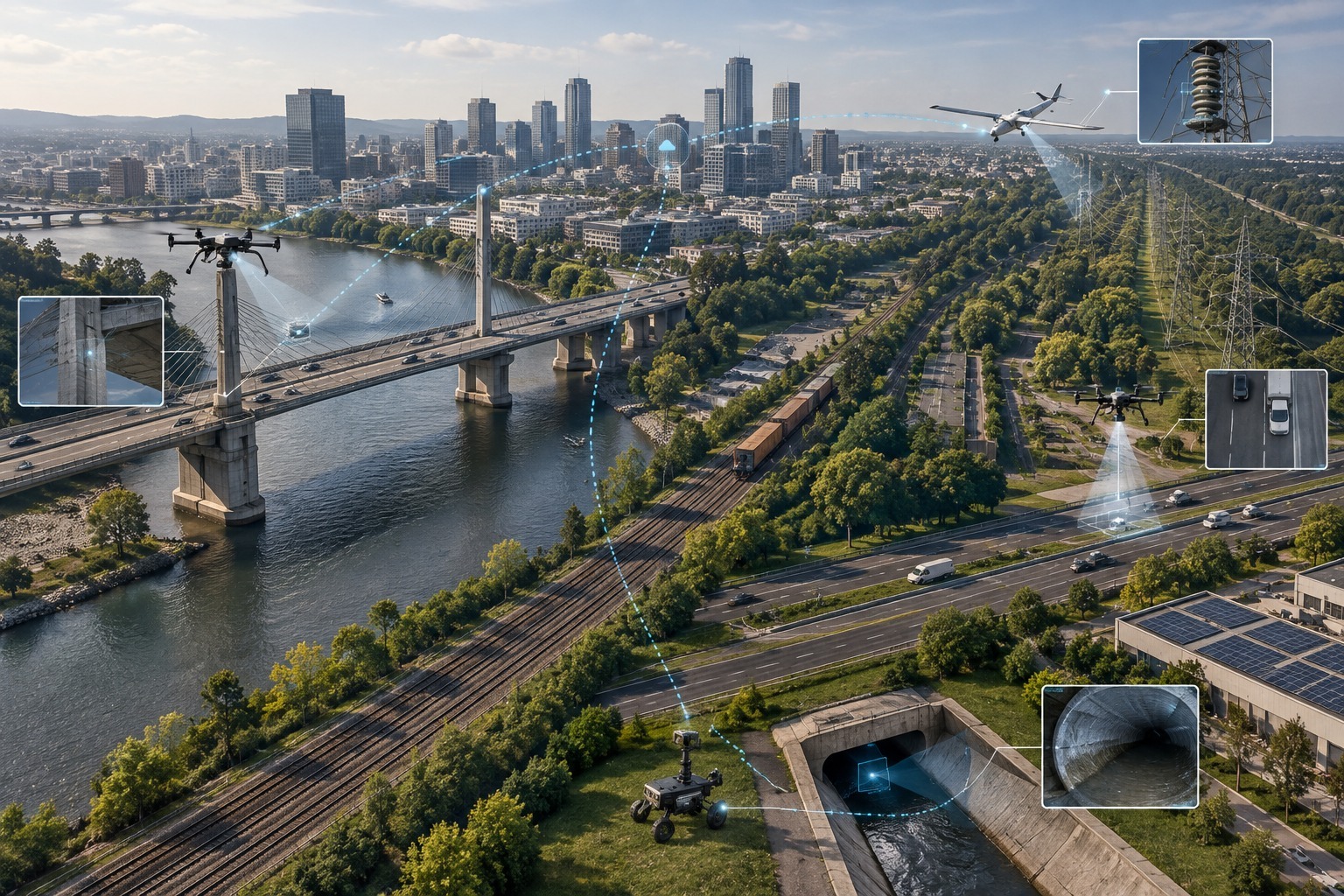
One autonomous system observes a bridge approach. Another checks a drainage corridor. Others inspect road access or utility infrastructure.
Instead of treating those machines as independent tools, autonomous systems software could coordinate priorities across the mission.
If one area shows no meaningful change, resources move elsewhere.
If another system detects something unusual, it can assign additional observation.
The inspection network adapts as evidence arrives.
Fleet-Scale Autonomy Changes the Economics of Inspection
This is where autonomous fleet management becomes more than monitoring dots on a map.
At fleet scale, the software must decide which assets need observation, which autonomous system should perform each task, what information has already been collected, where uncertainty remains, and how priorities should change as conditions evolve.
A machine may also become unavailable, lose connectivity, encounter weather, run low on energy, or determine that it cannot confidently inspect a particular area.
The mission should continue.
That requires collective intelligence AI: individual systems making local decisions while contributing to a broader operational objective.
The result is not a city filled with machines following predetermined routes.
It is an inspection network that can reallocate attention.
Infrastructure Still Needs Humans—But Humans Need Better Signals
A self-inspecting city should not be interpreted as a city without inspectors.
Engineers understand context that automated perception may not. Regulations require qualified personnel. Some defects require physical examination. Maintenance decisions involve safety, cost, history, and consequences that extend beyond what an image reveals.
Physical AI plays a different role.
Autonomous systems can serve as a persistent observational layer beneath human expertise.
They can revisit assets consistently, compare conditions, detect unusual change, collect evidence from difficult locations, and help prioritize where professional attention matters most.
Research from the Federal Railroad Administration provides a practical glimpse of this direction. Researchers tested a drone-based system on an operating railroad bridge using noncontact measurements of deformation and stress, concluding that the approach may be useful for bridge and structural inspection.
The long-term opportunity is to connect capabilities like these into coordinated operations rather than isolated inspection missions.
The City Becomes a Living Operational Picture
The future of infrastructure management is not simply “drones inspecting bridges.”
It is a city developing an increasingly current understanding of its own physical condition.
Roads are revisited. Bridges are compared over time. Utility corridors are observed. Post-storm changes are prioritized. Autonomous systems share tasks and adapt when conditions change.
Humans remain responsible for the decisions that require engineering expertise, safety judgment, and accountability.
But they no longer have to rely only on periodic snapshots of a continuously changing physical world.
That is the larger opportunity for Physical AI and AI software for autonomy: transform disconnected machines into an edge-first, resilient inspection network that continuously converts observations into operational awareness.
At AstraQua Inc., the important question is not how many autonomous machines a city can deploy.
It is whether those machines can reason and coordinate well enough to help the city understand what needs attention next.
Learn more about AstraQua's approach to Physical AI and autonomous systems software at www.astraqua.com.
Explore the related solution: Operational Self-Awareness with AstraSense and Fleet Coordination.