
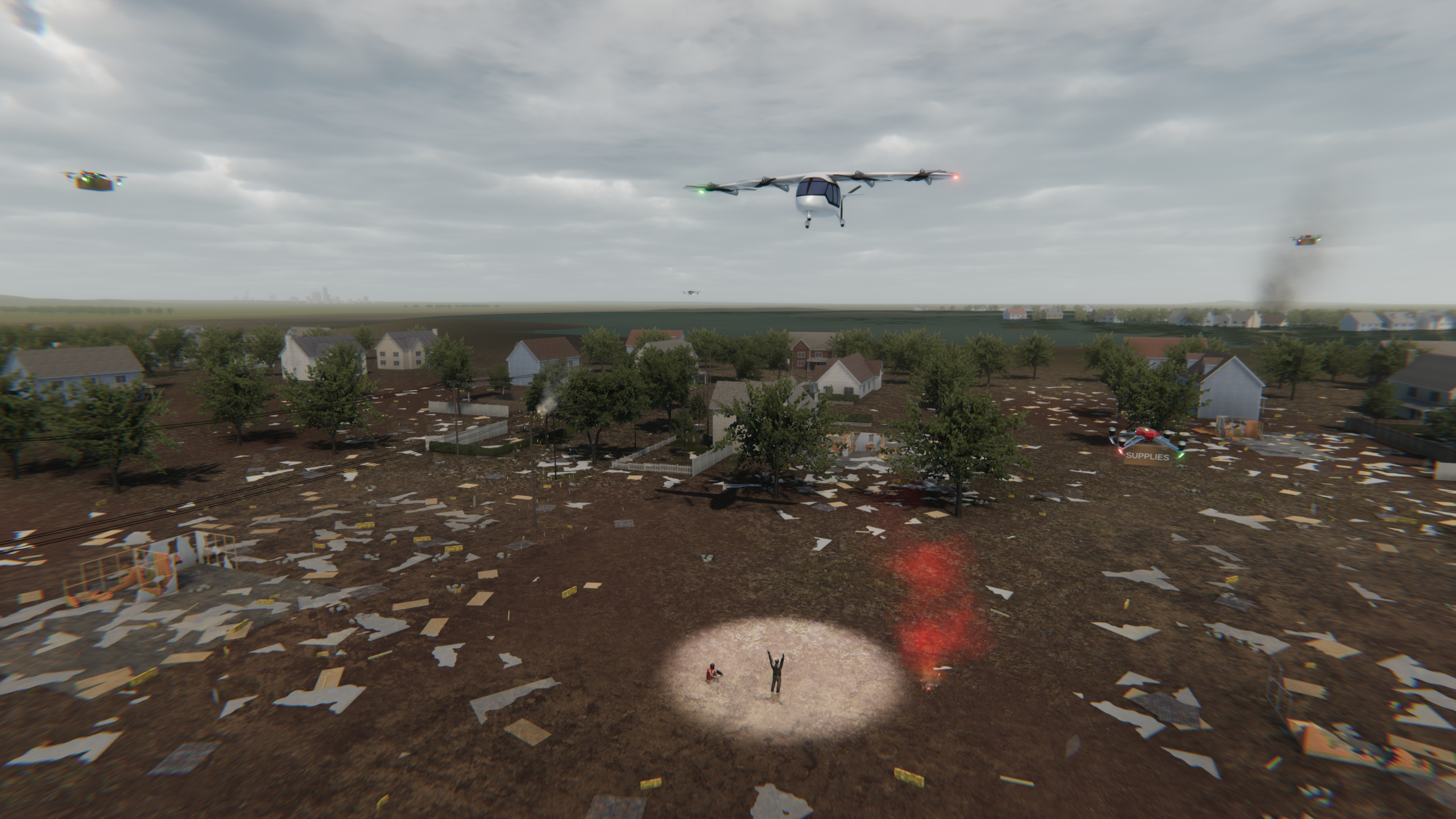

Most AI is designed for data centers — not for battery-powered, off-grid, real-world operations.
A drone fleet mid-mission loses cloud connectivity. Within seconds, AI decisions stop, navigation stalls, and coordination breaks down—the aircraft remain powered, but the intelligence has vanished. This is not a network failure; it is a fundamental design problem.
Or consider a ground robot on a six-hour inspection route inside an industrial tunnel. Signal drops. A cloud-dependent AI stack times out. Object detection freezes. The robot halts until connectivity returns. In mission-critical environments, pauses are failures. Most AI fails in the real world because it was never built for it.
The Design Mismatch: Data Center AI vs. Physical Environments
Modern AI systems were trained and optimized in environments with:
- Abundant power
- High-performance GPUs
- Persistent connectivity
- Centralized compute infrastructure
Real-world autonomous systems operate under very different constraints:
- Battery-powered hardware
- Strict energy budgets
- Intermittent or denied connectivity
- Real-time safety requirements
According to the International Energy Agency, data centers account for roughly 1–1.5% of global electricity demand. High-performance AI workloads significantly increase that footprint. That energy model works in a server rack. It does not translate to an edge device deployed in the field.
Now consider a drone running heavy cloud inference. Continuous uplink and downlink processing consumes 14 watts for continuous processing, compared to the 3 watts consumed by an optimized Physical AI model—which refers to AI that runs directly on a device to enable real-time decisions without needing a cloud connection—reducing battery draw by over 40% and cutting mission time nearly in half.
In real-world operations, energy is time. Time is mission success.
Why Cloud-Dependent AI Breaks in the Field
Cloud AI assumes connectivity. Real-world operations cannot.
A typical cloud-centric autonomy stack depends on:
- Continuous data transmission
- Remote inference
- Centralized coordination
- External instruction loops
When any of these fail, the system degrades.
Imagine a fleet conducting perimeter monitoring in a remote environment. Connectivity becomes unstable. Latency increases. AI decisions arrive milliseconds late, then seconds late. Eventually, they stop entirely.
For safety-critical systems, even small delays matter. A defense platform, an advanced air mobility corridor, or an industrial inspection route cannot wait for a data center to respond.
This is where terminology matters:
Edge AI is AI processing that happens on the device itself, not in a remote data center; this means the data stays on the local hardware for faster and more private processing.
Physical AI is AI that runs directly on a device, enabling real-time decisions without cloud connectivity.
Agentic systems act independently, adapting to conditions without waiting for external instructions, essentially functioning as self-driven software agents capable of achieving specific goals on their own.
| Feature | Cloud-Dependent AI | General Edge AI | AstraQua Physical AI (Agentic) |
|---|---|---|---|
| Compute Location | Remote Data Center | On-Device | On-Device |
| Connectivity Need | Persistent | Intermittent/Low | Zero (Operates Off-Grid) |
| Decision Style | Remote Instruction Loop | Local Inference | Independent Adaptation |
Most conventional AI is neither fully edge-native nor agentic. It relies on infrastructure that does not exist in constrained environments.
Energy Is the Hidden Failure Mode
Connectivity gets attention. Energy quietly determines success.
Autonomous systems deployed off-grid operate within strict power envelopes. Every watt matters. Compute-heavy AI models designed for GPUs in data centers consume more power than embedded systems can sustainably provide.
Consider a drone performing terrain mapping. If inference runs remotely, the system must:
- Capture data
- Compress and transmit
- Wait for cloud inference
- Receive results
- Execute decisions
Each step consumes energy.
If inference runs locally using optimized models, transmission overhead disappears. Decision cycles shrink. Power consumption stabilizes.
Energy-efficient AI architectures are not about marginal gains. They determine whether a system completes a mission or lands early.
Research in edge computing consistently shows that localized processing reduces both latency and energy consumption compared to centralized cloud architectures. In energy-limited environments, that difference is operationally decisive.
From Single Devices to Fleet-Scale Autonomy
Autonomy becomes more complex at fleet scale.
A single device making decisions locally is useful. Intelligent fleet coordination without central dependence is transformative.
Imagine a distributed inspection fleet across an industrial site. If all coordination routes through the cloud, the system inherits a single point of failure. If each unit runs agentic Physical AI, the fleet can:
- Continue operating even if connectivity drops
- Share state information when available
- Adapt collectively to changing conditions
- Maintain uptime during partial system failures
This approach shifts autonomy from centralized orchestration to distributed intelligence. Decisions live where action happens.
For defense program managers, industrial operators, and advanced air mobility planners, this architecture increases resilience. Operations continue even in degraded conditions.
A Software-First Model for Real-World Autonomy
AstraQua Inc builds agentic Physical AI software that enables autonomous fleets to decide, coordinate, and operate together without relying on the cloud.
Instead of adapting data center AI to edge environments, the platform is optimized for:
- On-device inference
- Energy-efficient execution
- Decentralized coordination
- Reinforcement-learning-driven adaptation
- Fleet-scale reliability
This software-first approach separates intelligence from hardware constraints. Developers integrate AI into embedded systems. Operators deploy autonomy at scale. The architecture supports AI for drones, AI for robotics systems, AI for advanced air mobility, and AI for industrial and government operations without becoming cloud-dependent.
Reliability Is an Architectural Decision
In real-world operations, AI reliability is not a feature. It is a design outcome.
A cloud-first AI stack assumes infrastructure stability. A Physical AI stack assumes constraint.
Consider a six-hour inspection mission:
- Cloud-dependent AI: stops when the signal drops.
- On-device agentic AI: continues to operate, adapts locally, and syncs when connectivity returns.
The difference is architectural.
As autonomous fleet management scales globally, organizations require AI software for autonomy that survives real-world constraints. Distributed AI systems designed for energy-limited environments provide that resilience.
The future of AI for real-world operations is not larger models in bigger data centers. It is efficient, embedded, agentic intelligence operating at the edge.
Power-Constrained AI Is the Standard, Not the Exception
Edge and remote deployments are increasingly common across:
- Industrial autonomy
- Government and defense systems
- Advanced air mobility
- Distributed inspection and monitoring
In each case, systems must:
- Operate off-grid
- Minimize energy consumption
- Maintain real-time decisions
- Scale across fleets
Energy-efficient, on-device AI is no longer an optimization. It is a prerequisite for mission success.
The organizations that recognize this shift are building architectures that assume constraint, not abundance.
See On-Device AI in Action
If you operate autonomous fleets or design embedded systems for real-world missions, cloud-dependent AI is a liability. Take the next step toward resilient autonomy: Request a demo to see on-device AI in action. Download the technical brief on energy-efficient fleet autonomy. These resources are designed for drone operators, embedded developers, and defense program managers.