
The Software Brain for Resilient Autonomy

AstraQua’s AQFM™ provides the software brain that treats energy, not data, as the ultimate mission constraint.
Imagine 120 coordinated units operating in a GPS-denied environment. As wind conditions shift and connectivity falters, the mission destabilizes—not because the algorithms are wrong, but because the hardware reaches its physical limit. To survive, these swarms need more than a pilot; they need AQFM™, a software brain capable of local reasoning and decentralized adaptation.
Failure occurs when intelligence ignores physics. Resilient autonomy is first and foremost an energy-allocation challenge.
Core Thesis: In distributed autonomous systems, energy—not raw compute—is the bottleneck. Reliability is defined by the system’s ability to manage health and prognosis (NASA TX10.2.5) within fixed resource envelopes.
Defining Resilient Autonomy
Resilient autonomy is the coordination of 100+ units operating as a cohesive, decentralized swarm. It moves beyond simple pathfinding to collective adaptation under strict battery and thermal limits. While manageable at low densities, scaling to 100+ units introduces non-linear failure modes that require edge-first intelligence to mitigate.
The Failure Cascade in Physical Systems
Most AI systems were designed for data centers, assuming abundant compute, stable power, persistent connectivity, and elastic scaling.
Physical systems assume none of these. They are:
- Battery-powered and energy-limited
- Thermally constrained
- Operating at the edge of connectivity
The Thermal Ceiling: A mobile system increases inference frequency to compensate for noise. This triggers a physical cascade: compute spikes, thermal throttling activates (NASA TX10.2), and decision latency rises. The resulting failure is physical, not algorithmic. This is the hidden fragility of autonomy at scale.
Physical AI: The Ingenuity Heritage
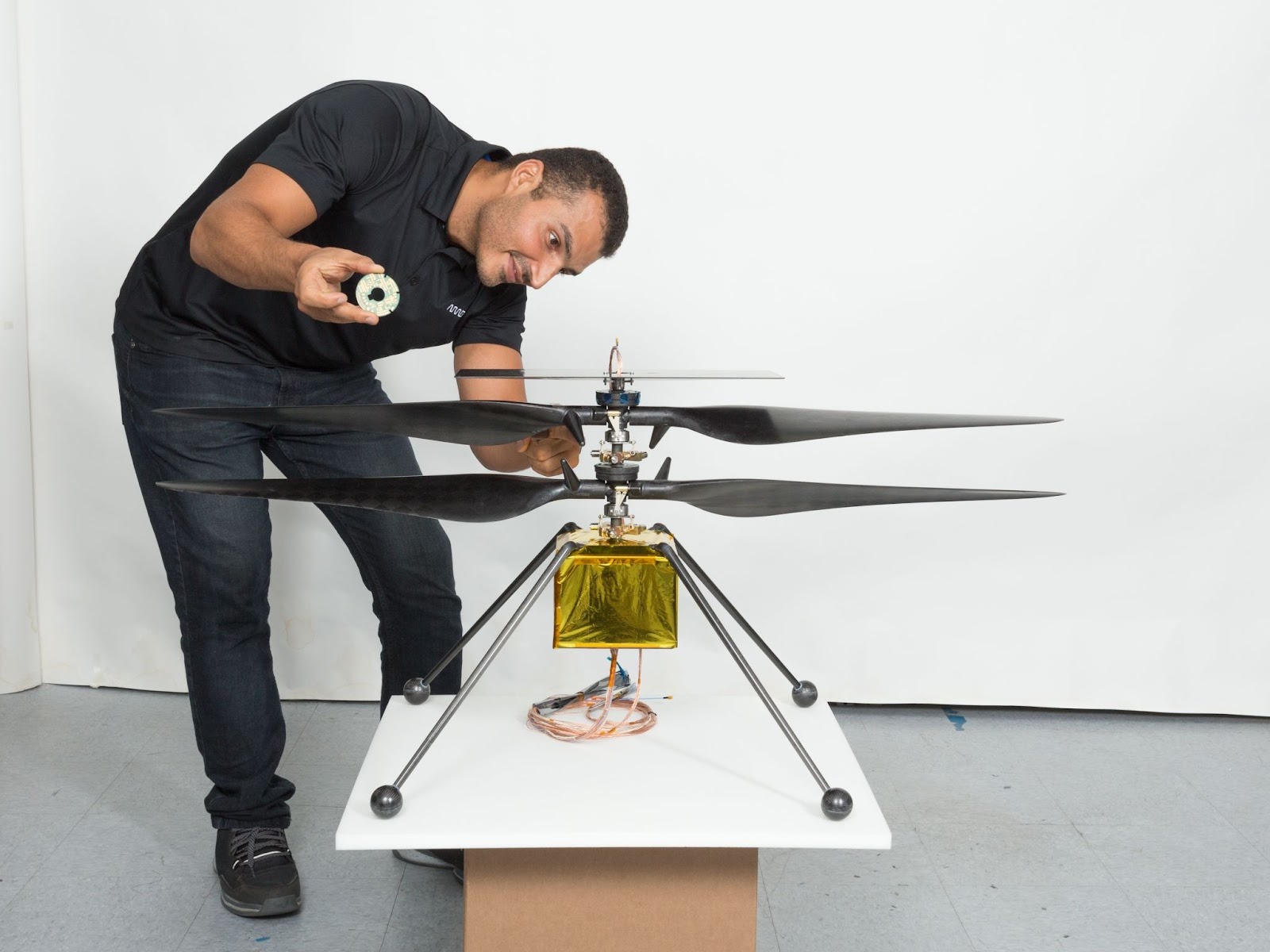
Physical AI is software that perceives, reasons, and acts locally. Much like the Mars Ingenuity Helicopter—where edge-first intelligence enabled survival in a disconnected, extreme environment—our software brain prioritizes efficient, low-latency inference on-device.
It prioritizes:
- Low-latency, efficient inference
- Stable operation without cloud dependency
- Resilience under degraded conditions
When communications drop, centralized coordination is a liability. Survivability depends on autonomous agents that maintain mission tempo without the cloud. The environment, and its energy constraints, must define the architecture.

AstraQua’s Loay Elbasyouni with Mars Ingenuity, where edge-first intelligence proved that decentralized systems can thrive under extreme constraints.
Agentic Systems Under Constraint
Agentic systems are swarms capable of adapting behavior toward shared goals. In practice, this requires independent local reasoning and rapid adjustment to coordinated unit behavior, all while maintaining strict adherence to energy budgets.
But agentic coordination is not free:
- Every communication consumes energy.
- Every inference consumes compute.
- Every update generates heat.
The Coordination Tax: During a large-area mapping mission, 80 units adjust formation. If coordination relies on high-bandwidth synchronization, energy drains rapidly. Agentic autonomy only scales when designed for the efficiency of decentralized communication.
The Energy Bottleneck
Research across edge computing and embedded AI consistently highlights power consumption as the dominant constraint in distributed systems. Energy-efficient inference significantly reduces total system load compared to centralized cloud loops, particularly at scale.
For coordinated units, energy compounds: 100 systems consuming excess power is a total mission failure.
Heat becomes a secondary constraint. Increased compute leads to thermal throttling, which increases latency, ultimately reducing coordination stability.
Prognostic Reliability: Aligning with NASA TX10.2.5, AQFM™ ensures units hitting thermal limits adjust model complexity to preserve fleet synchronization. Energy management determines reliability.
Connectivity Is Not Guaranteed
Cloud-first AI architectures assume reliable bandwidth and centralized coordination. Physical deployments often encounter GPS degradation, network congestion, denied environments, and latency spikes.
If 100 units lose connectivity, cloud-dependent swarms halt. To survive, autonomy must persist locally. Our software brain ensures mission tempo is maintained regardless of infrastructure availability.
Decentralized Intelligence at Scale
Distributed autonomous systems scale when intelligence is:
- On-device: Reduces latency and avoids cloud dependency.
- Energy-aware: Extends mission duration and protects thermal stability.
- Decentralized: Prevents single points of failure.
- Resilient: Maintains function during communication loss.
Reinforcement learning approaches allow systems to adapt behavior gradually without increasing compute load unnecessarily.
Efficient Scaling Scenario: A swarm in a remote environment learns routing strategies locally. These improvements are shared via decentralized protocols, keeping power budgets stable and the mission resilient. Scaling autonomy requires scaling efficiency.
The Real Failure Mode at 100+
At 10 units, inefficiencies are tolerable. At 100+, they compound non-linearly:
- Slight power inefficiencies drain batteries across coordinated units.
- Minor latency increases destabilize coordination.
- Small communication overloads fragment synchronization.
The system appears intelligent until resource constraints stack. Swarm-scale autonomy is tested during degradation. Our architecture assumes failure, designing for resilience when GPS and power budgets are compromised.
AstraQua’s Perspective
AstraQua provides the software brain for machines to perceive, reason, and act locally. We optimize for power, compute, and decentralized coordination to ensure mission success.
Key principles:
- Intelligence lives on-device.
- Coordination is decentralized.
- Power efficiency is foundational.
- Cloud dependence is optional, not required.
This reduces mission fragility for operators, ensures AI respects compute budgets for embedded developers, and enables predictable scaling for program managers.

Kosta Varnavas with the Mars Ingenuity model, illustrating the edge-first principles foundational to AQFM™.
Reframing Autonomy
The industry frames autonomy as an algorithmic challenge. It is an energy allocation challenge. The future belongs to those who deliver edge-first intelligence that respects physical limits while designing for real-world degradation.
It will be defined by who can:
- Deliver edge-first intelligence
- Optimize for power and thermal limits
- Maintain coordination under intermittent connectivity
- Design for degradation, not ideal conditions
This is the shift from demonstrations to durable, fleet-scale operations. It is about resilient computing. It is about power-aware, decentralized intelligence that survives when the infrastructure does not.
To explore how energy-aware, edge-first autonomy changes what is possible at scale, connect with AstraQua at www.astraqua.com and engage with our team for deeper technical discussion.