
In this article
- Predictive Health Is More Than an Alarm
- NASA Electrified Aviation: A Demanding Starting Point
- Why the Same Health Problem Extends Beyond Aircraft
- Detection Is Only the Beginning
- From Remaining Useful Life to Remaining Operational Capability
- Prediction Only Matters If It Changes the Decision
- Predictive Health Is Part of the Software Brain
- From Reactive Faults to Health-Aware Autonomy
An electric drive system is operating normally when one signal begins to drift. Nothing has failed. The motor still turns. The inverter still switches. The battery still supplies power. Sensors and controllers remain online. But the pattern may indicate that part of the system is moving away from normal condition.
The important question is not simply, “Is something broken?”
It is: What is changing, why is it changing, how quickly could it get worse, and how much remaining operational capability does the system have?
That is the purpose of predictive health. AstraSense is the specialized health-intelligence agent within AstraQua’s modular autonomy architecture in development. Its role is to turn changing machine signals into condition, prognosis and remaining-capability context that can inform mission reasoning through the broader AQFM foundation.
Predictive Health Is More Than an Alarm
Traditional fault monitoring often works around thresholds: a variable crosses a limit, a fault is declared, and the system responds. That is useful, but it is reactive.
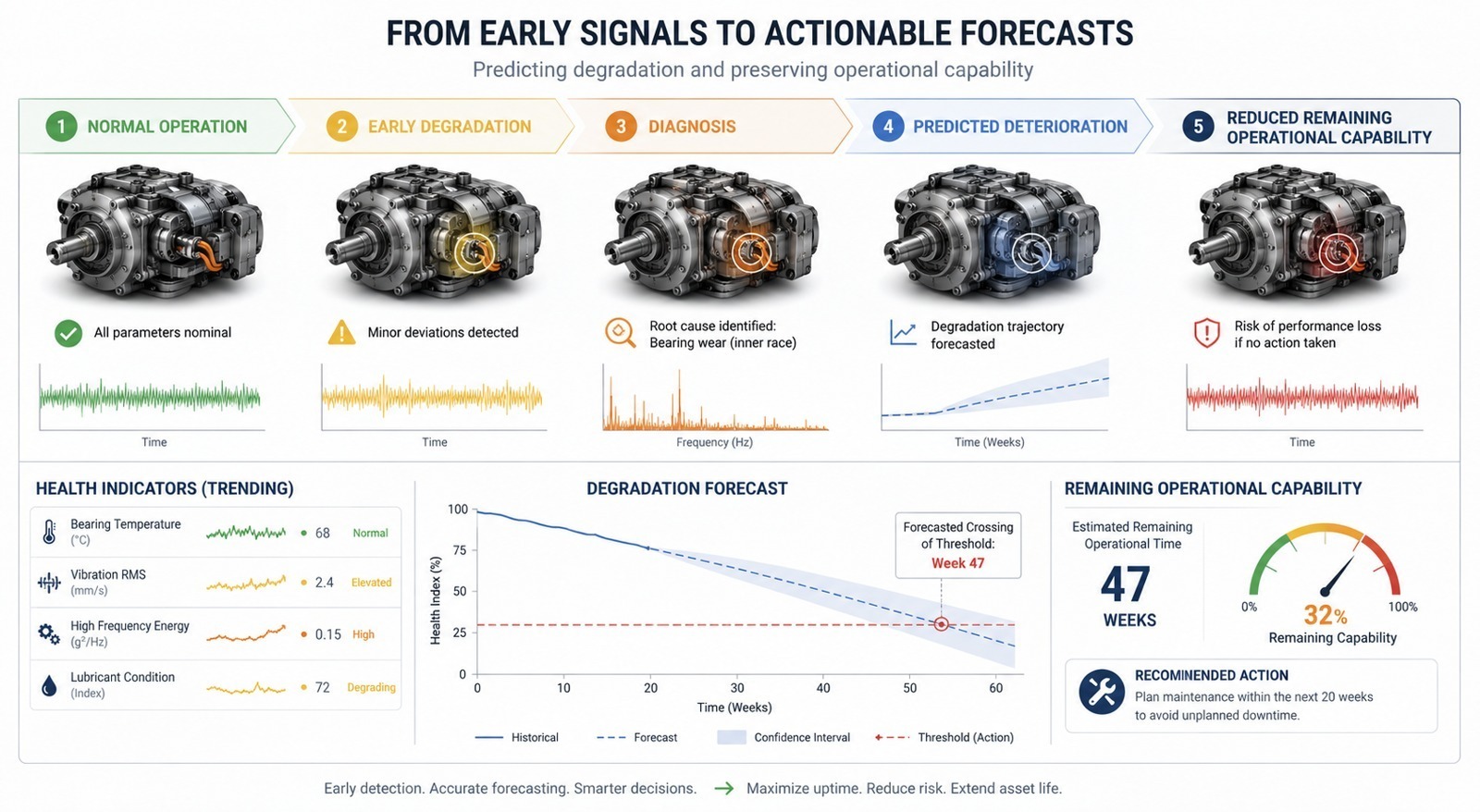
Predictive health starts earlier. A useful process has five connected stages:
- Detect early degradation. Identify trends that depart from expected behavior before a hard fault occurs.
- Diagnose what is changing. Determine which component, subsystem, or failure mode best matches the evidence.
- Forecast progression. Estimate how degradation may evolve under expected operating conditions.
- Estimate remaining operational capability. Determine remaining useful life, operating margin, or mission capability—not just whether the component is still functioning.
- Enable action. Provide information early enough to change the plan before the condition becomes mission-limiting.
NASA research on aircraft-engine prognostics has modeled damage progression toward a defined failure criterion, using a health index to represent movement toward end of useful life. The larger value is not the alarm itself, but the ability to estimate where the condition is heading.
NASA Electrified Aviation: A Demanding Starting Point
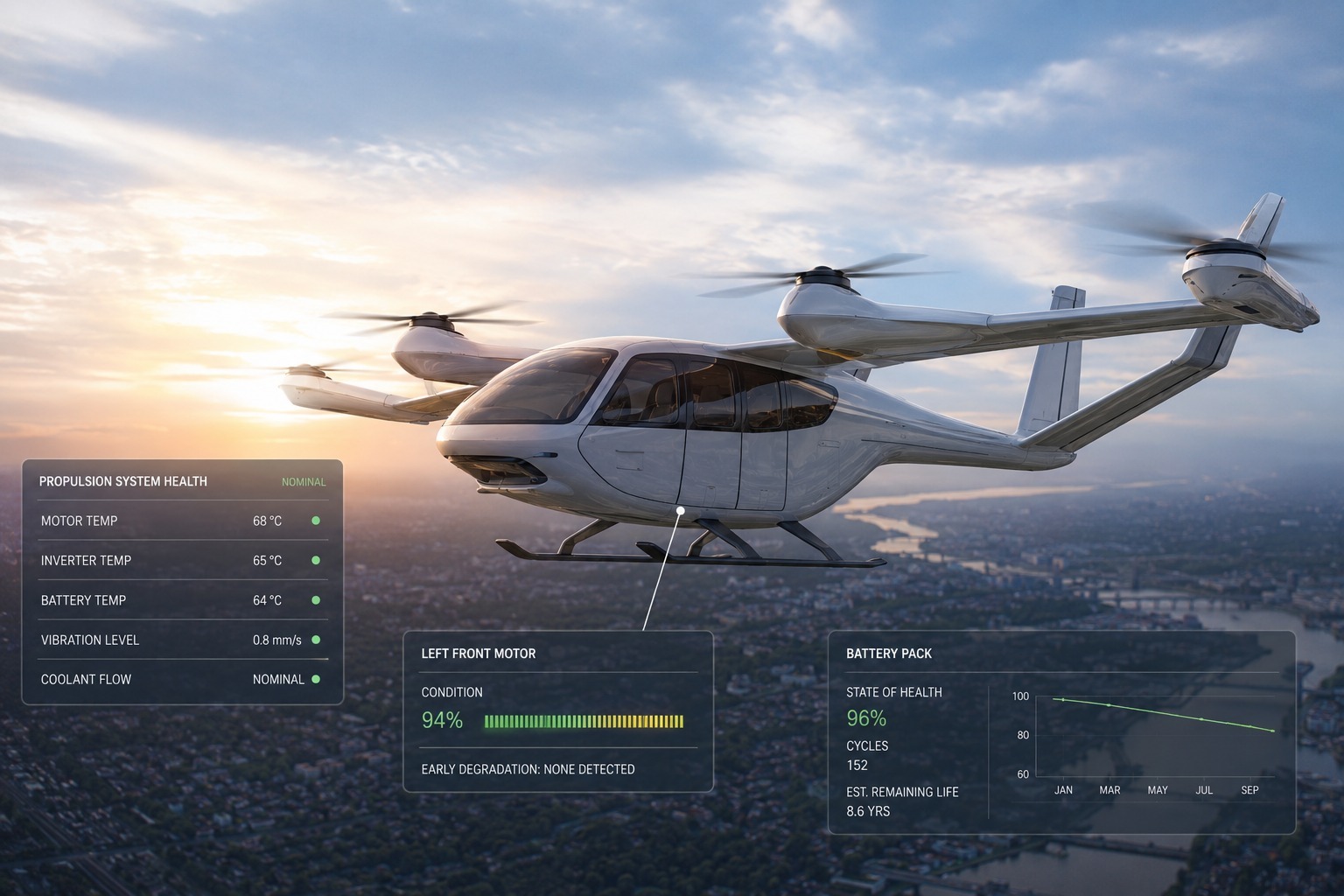
AstraQua Inc completed a NASA SBIR Phase I project in Advanced Air Mobility and sustainable aviation focused on AI-enabled health monitoring, diagnostics, and prognostics for electrified aircraft propulsion systems.
The NASA-selected project, AstraSense: AI-Driven Health Predictions for Sustainable Aviation, addressed hybrid-electric and all-electric aircraft. NASA’s published project description identifies early-stage degradation detection and failure prediction in high-voltage, high-noise operating environments as central goals.
Phase I established feasibility work; it should not be read as a claim that NASA has already fielded a production aircraft system using AstraSense.
NASA selected AstraQua for Phase II contract negotiation. AstraQua subsequently announced receipt of a Phase II award in its October 12, 2026 company update. The next stage is intended to mature the technology through further development, integration, demonstration, and relevant-environment validation—the point at which predictive health must perform amid real operating noise, changing loads, uncertainty, and physical constraints.
Electrified aviation is therefore an important proving ground for AstraSense, not the boundary of the technology. The underlying health-management problem appears across many electrically powered autonomous systems.
Why the Same Health Problem Extends Beyond Aircraft
Electric aircraft, drones, mobile robots, spacecraft, autonomous vehicles, and industrial machines perform different missions, but many rely on common classes of hardware: motors and actuators, batteries, inverters and converters, sensors, controllers, power distribution, and embedded computing.
Their failure physics, loads, environments, and safety requirements differ, so health models must be adapted to each platform. The core questions remain similar: What is changing? How fast is it progressing? And what capability will remain under the next operating demand?
That creates a path for AstraSense beyond aviation. A motor drive on an aircraft and one on a robot are not the same system, but both can benefit from earlier detection, diagnosis, prognosis, and a machine-readable estimate of remaining capability that can inform autonomous decisions.
Detection Is Only the Beginning
Early detection says behavior is changing. Diagnosis adds context.
A temperature increase, current fluctuation, vibration change, or altered electrical signature may have several possible causes. The system must distinguish meaningful degradation from normal variation caused by load, environment, or mission conditions.
Research by Daigle and Goebel at NASA Ames developed model-based prognostics that estimate system state and damage progression together, then propagate those estimates forward to predict end of life and remaining useful life. Their work treats prediction probabilistically, reflecting the uncertainty inherent in forecasting physical degradation.
For autonomous systems, that uncertainty matters. A machine should not treat an estimated remaining capability as perfectly certain when the underlying prediction has a wide range.
From Remaining Useful Life to Remaining Operational Capability
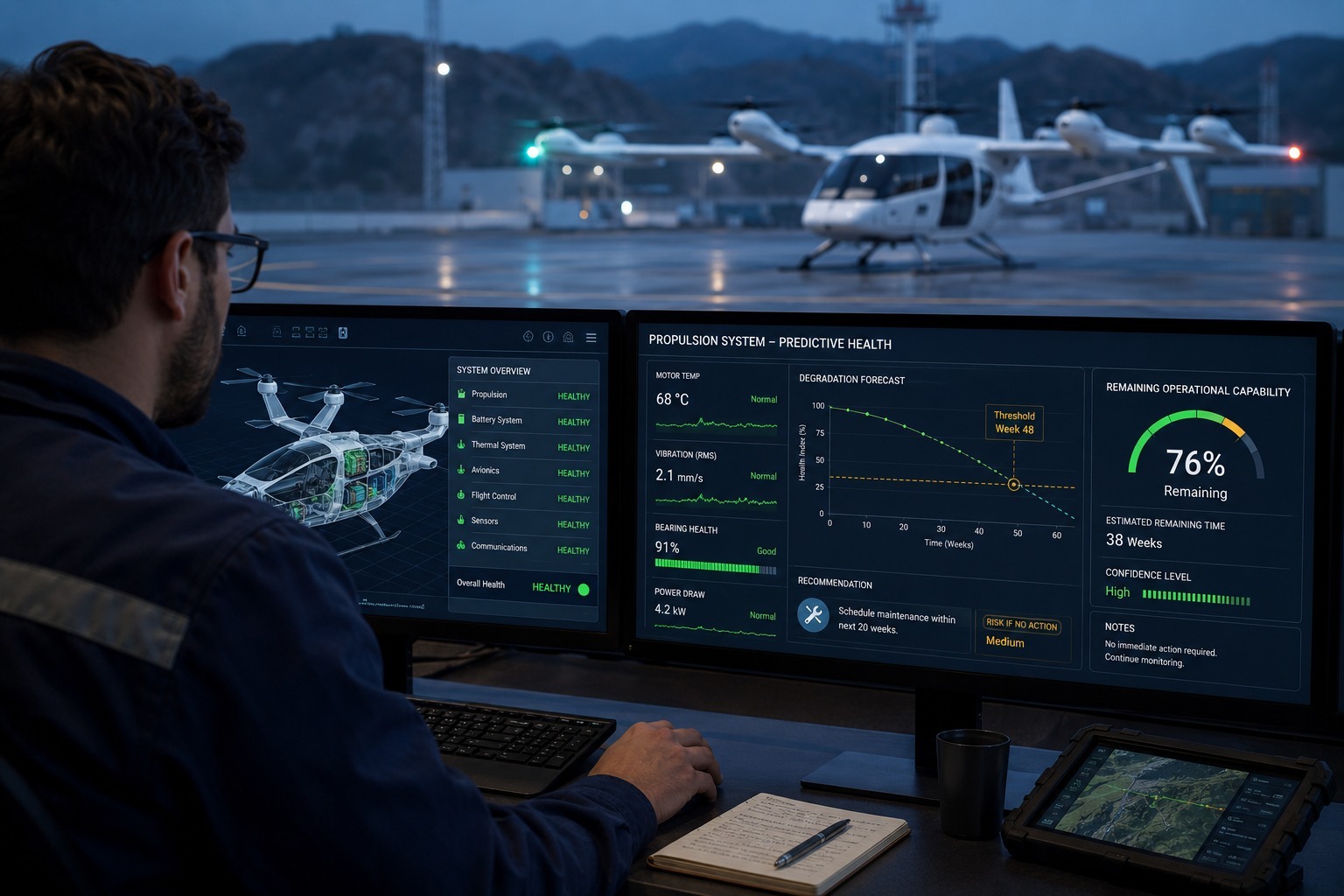
Remaining useful life is a familiar prognostics measure, but autonomous operations often need a broader question:
What can this system still safely do?
A battery may not be near end of life yet still lack enough available energy or power for the planned mission. A motor or inverter may continue functioning while thermal or electrical constraints reduce the safe operating envelope.
NASA research on lithium-ion batteries has shown how state-of-health and aging models can predict both end-of-discharge and end-of-life under anticipated usage. In other words, remaining capability depends partly on what the system is being asked to do.
Predictive health therefore connects component condition to future mission demand: the relevant question is not only how long a component may last, but whether the system retains enough margin to complete the next task safely.
Prediction Only Matters If It Changes the Decision
The operational value of prognostics appears when the prediction becomes actionable.
If degradation is progressing slowly, the system may continue while monitoring more closely. If uncertainty is high, it may choose a conservative plan. If capability is shrinking quickly, it may reduce workload, derate propulsion, change route, transfer a task, schedule maintenance, or return before the condition becomes critical.
Predictive health does not replace perception, planning, or control. It gives those functions better knowledge of the machine they control.
Predictive Health Is Part of the Software Brain
Predictive maintenance is a process: monitor health, anticipate service needs, and schedule intervention. An autonomous machine needs that health intelligence earlier—while it is still making decisions.
AstraSense is designed not as an after-the-fact maintenance tool, but as part of the software brain. It provides an evolving view of physical condition that can influence decisions during operation.
NASA’s 2024 Technology Taxonomy provides a useful framework. TX10.1 includes state estimation and monitoring, event and trend identification, and anomaly detection; TX10.2.5 covers fault diagnosis and prognosis. AstraSense functions align with this bridge from machine state to usable health knowledge.
Predictive maintenance asks when to service the machine. Predictive health asks what is changing and where it is heading. Operational self-awareness asks what the machine can safely do given its condition and mission.
Predictive health is one building block of machine self-awareness, not the whole of it. Sensor trust, energy, compute, uncertainty, connectivity, and mission readiness belong to the broader discussion in our companion article, “Why Machines Need to Know Their Own Health Before They Can Work Autonomously.”
From Reactive Faults to Health-Aware Autonomy
The next generation of Physical AI cannot wait for a hard fault before understanding that something is wrong. Reliable autonomy requires machines that can recognize degradation early, determine what is changing, forecast how it may progress, and translate that forecast into remaining operational capability.
NASA-supported development began with electrified aircraft propulsion. The broader goal is health intelligence that can serve autonomous machines—from aircraft and drones to robots and spacecraft—early enough to influence the next decision, not merely explain the last failure.
Detect earlier. Diagnose intelligently. Predict what comes next. Understand what capability remains.
Explore AstraQua’s approach to Physical AI and autonomous systems software at www.astraqua.com.
Explore the related solution: Operational Self-Awareness with AstraSense.