
In this article
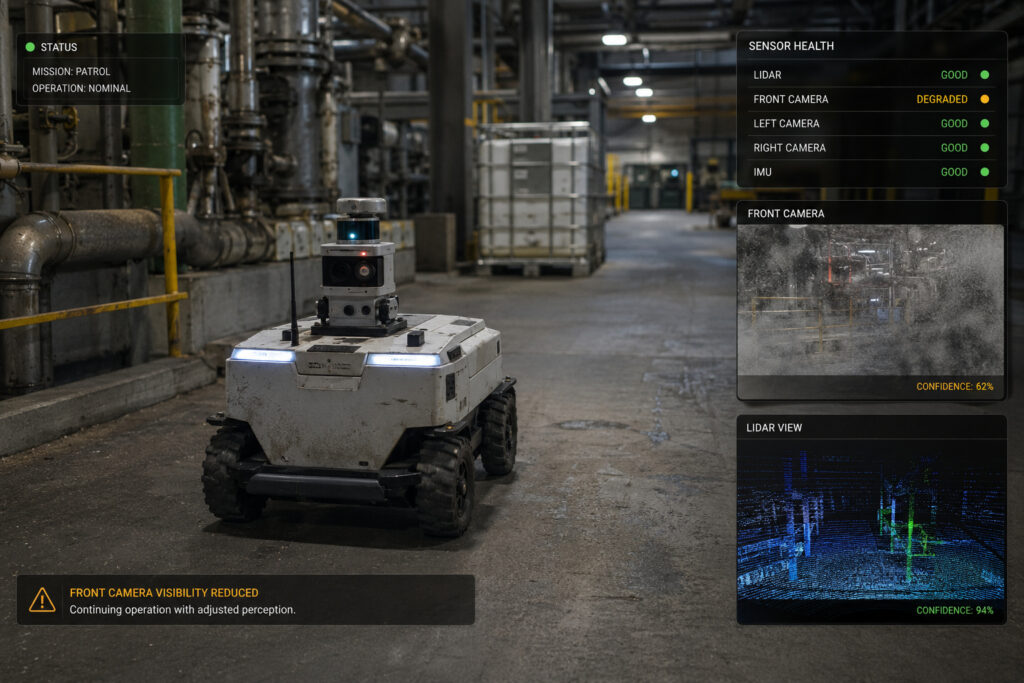
An autonomous ground robot is moving through an industrial facility when dust begins coating one of its cameras. The camera still has power. Frames are still arriving. No simple “sensor failed” alert appears.
But the images are becoming blurred.
If the robot keeps treating that camera as fully trustworthy, its AI software brain may make increasingly confident decisions from increasingly unreliable information.
That is why autonomy requires more than understanding the outside world. A machine also needs operational self-awareness: the ability to assess its own condition and determine what it can still do safely and reliably.
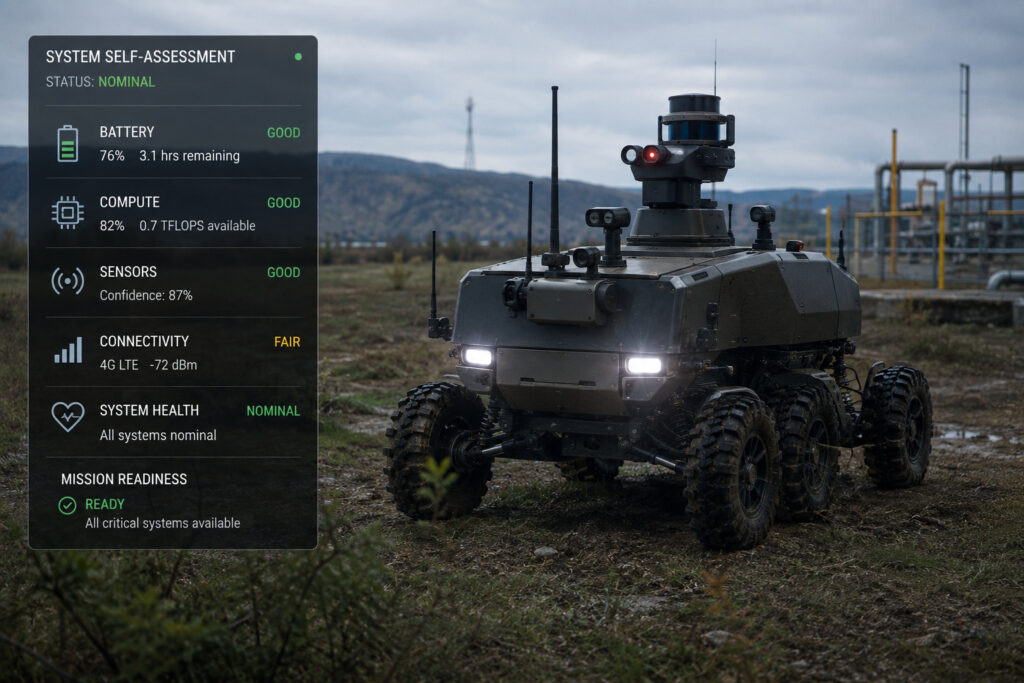
This does not mean human consciousness, emotion, or sentience. In engineering terms, operational self-awareness means understanding health, available capabilities, energy and compute resources, sensor condition, degradation, uncertainty, connectivity, and overall mission readiness.
Today’s AI Software Brains Mostly Look Outward
Much of modern AI for robotics focuses on external perception.
Can the machine recognize an object? Detect an obstacle? Estimate its position? Understand its surroundings? Navigate toward a destination?
Those capabilities are essential. But they tell the machine primarily about the world around it.
A truly autonomous system must also determine whether its sensors are trustworthy, how much energy and compute remain available, whether its capabilities have degraded, how certain it is about its own state, and whether it can still complete the next task safely.
A 2004 study by Karl Reichard described “internal self-situational awareness” as knowledge of platform health and capability, arguing that autonomous systems need to compare their current capabilities with mission demands.
Operational self-awareness brings that principle into today’s Physical AI systems.
A Powered-On Sensor Can Still Be an Unreliable Sensor
Sensor condition makes the concept concrete.
A camera can be powered on yet blurred by condensation, partly obstructed by dirt, miscalibrated after vibration or impact, or unreliable under changing lighting conditions.
An inertial measurement unit, or IMU, can continue producing data while developing bias or drift.
Simply checking whether a sensor is online is therefore not enough. The machine needs some way to evaluate how much it should trust that sensor right now.
Hendrycks and Dietterich’s ImageNet-C research tested image classifiers against common corruptions such as blur, noise, fog, brightness changes, and digital distortions. Their results demonstrate why strong perception performance under clean conditions does not guarantee the same reliability when input quality deteriorates.
For an autonomous machine, recognizing when perception becomes uncertain may be as important as interpreting what the sensor sees.
NASA Places Self-Awareness Inside Autonomous Systems
NASA’s 2024 Technology Taxonomy makes this broader view of autonomy explicit.
Under TX10 Autonomous Systems, NASA identifies “Situational and Self-Awareness Technologies” as a major technology area. It includes sensing and perception, state estimation and monitoring, event and trend identification, and anomaly detection.
NASA then connects that awareness to reasoning-and-acting capabilities including mission and resource planning, fault diagnosis and prognosis, fault response, and learning and adaptation.
That structure matters because autonomy is not one algorithm.
A machine needs credible knowledge about both its environment and its own state before it can make reliable decisions about what happens next.
Predictive health is one important input to that internal picture. AstraQua’s NASA work on health monitoring for electrified aircraft is one real-world example of building health awareness, but operational self-awareness is broader than predictive health alone.
Health Is Only One Part of “Can I Still Do This?”
Consider a robot assigned to inspect three locations.
Mechanically, it may appear healthy. But its battery reserve has fallen. Its processor is thermally constrained. One camera now has reduced confidence. The wireless link is intermittent.
None of those conditions alone necessarily means the robot has failed.
Together, however, they change what it can reliably accomplish.
Operational self-awareness means combining internal condition with mission context. The appropriate response might be to continue at lower speed, rely more heavily on another sensing source, reduce nonessential compute, reorder tasks, request assistance, or stop before risk becomes unacceptable.
Research on embedded health management for UAV platforms has similarly explored monitoring system components in the context of mission conditions so emerging failures can be identified and connected to appropriate recovery actions.
The key shift is from asking “Am I functioning?” to asking “What am I capable of doing now?”
Self-Awareness Enables Collective Adaptation
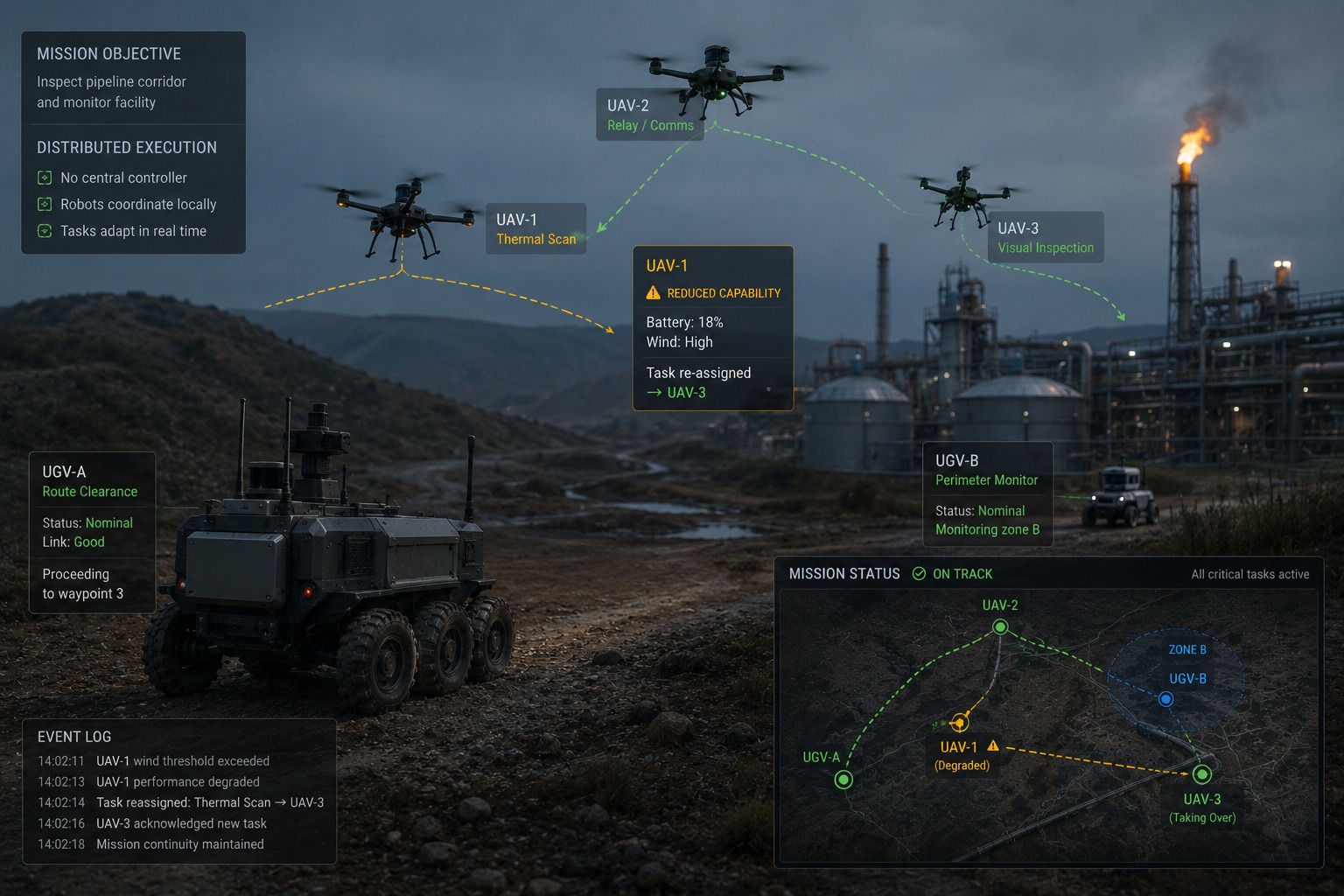
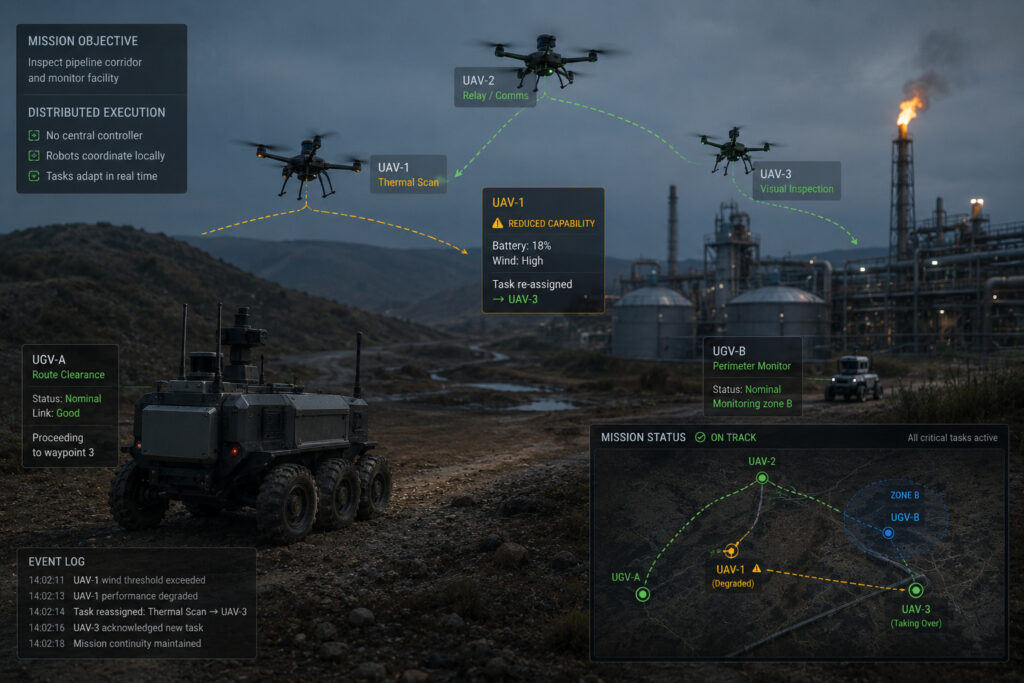
The same principle becomes more powerful when multiple autonomous systems operate together.
If each system understands its own capabilities, the wider mission community can adapt intelligently.
A unit with degraded sensing can hand off an inspection task. A low-energy unit can take a shorter assignment. A machine with stronger compute availability can accept a more demanding local workload.
This turns fleet-scale autonomy into more than centralized task assignment. It becomes collective adaptation based on what each participant can actually contribute.
Connectivity supports that coordination, but it should remain a supporting consideration rather than the foundation of awareness itself. Each machine needs enough on-device intelligence to evaluate its own condition even when communication becomes limited.
The Next AI Brain Needs an Internal View
Autonomous machines are getting better at seeing, navigating, recognizing, and planning around the world outside them.
The next step is giving the AI software brain a credible view inward.
Operational self-awareness means knowing when a camera cannot be trusted, when energy or compute is constrained, when uncertainty is rising, when degradation changes available capability, and when the original mission plan no longer fits the machine’s current condition.
Predictive health helps explain where that condition may be heading.
Operational self-awareness asks the larger question: given my health, sensing quality, resources, uncertainty, connectivity, and mission demands, what can I safely and reliably do now?
At AstraQua Inc, that is the broader direction for Physical AI: resilient, edge-first autonomous systems that do not merely perceive the world and execute plans, but understand their own changing ability to carry those plans out.
Explore AstraQua’s approach to autonomous systems software at www.astraqua.com.