
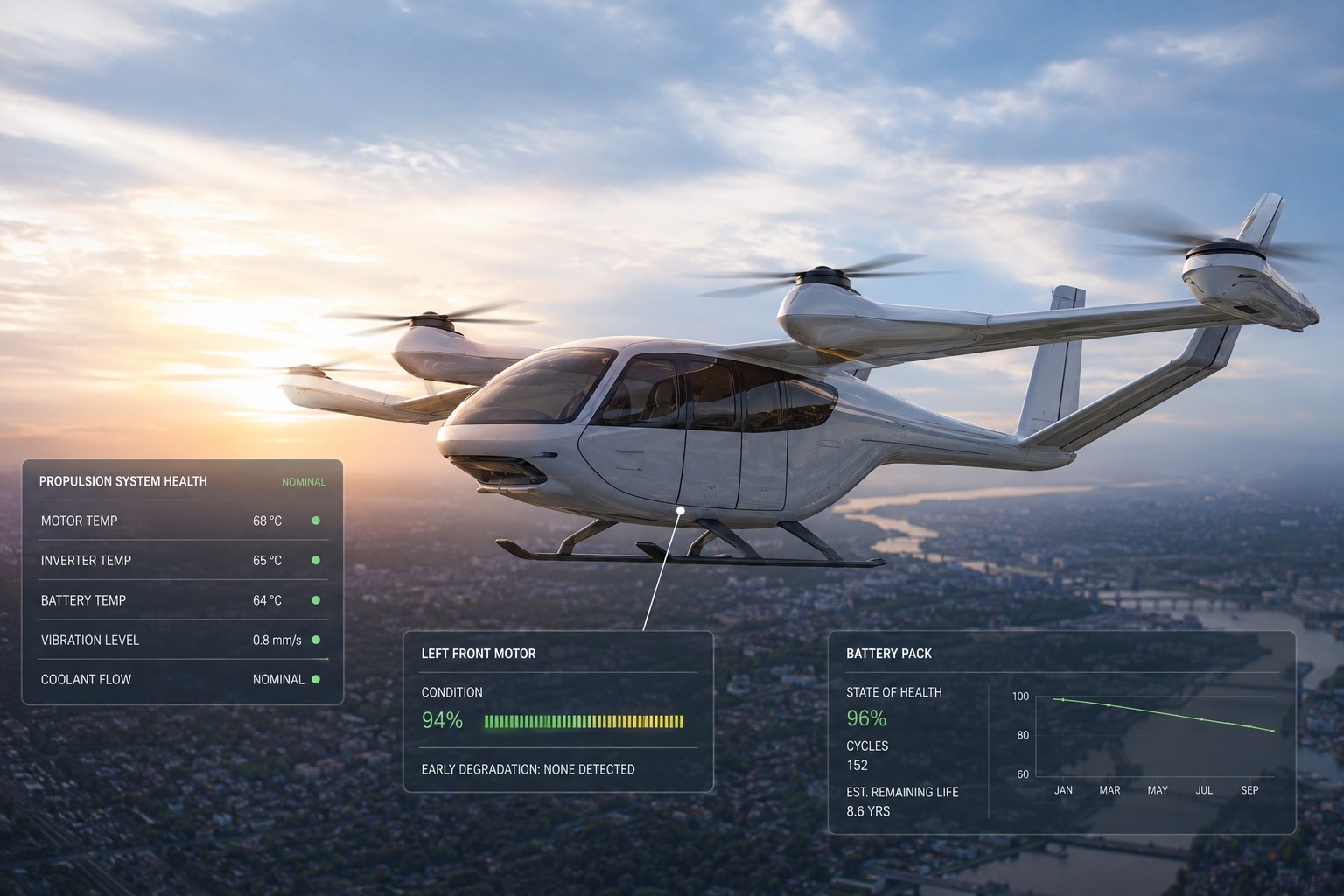
AstraSense connects real-time machine-health awareness with the needs of electric and hybrid-electric aircraft.
Company update · October 12, 2026
Following NASA’s selection, AstraQua announced in its October 12 company update that it had received a Phase II award to continue AstraSense development. The update builds on the original selection announcement below.
Original selection announcement · July 21, 2026
NASA selected AstraQua’s proposal, “AstraSense: AI-Driven Health Predictions for Sustainable Aviation,” for Phase II contract negotiation. NASA’s public selection archive identifies proposal A1.11-1015 and a planned development path from technology readiness level 4 to level 6.
AstraSense gives autonomous machines real-time information about their own condition, supporting diagnostics, predictive health and operational reasoning. The technology already runs on robotic hardware. During Phase I, AstraQua demonstrated real-time diagnostics and predictive-health capabilities using motors, inverters and electrical systems.
The aviation effort addresses health management in electrified propulsion systems, where developing degradation must be interpreted under demanding electrical conditions. NASA’s abstract describes further integration and validation of an embedded prototype, including hardware-in-the-loop and representative propulsion testing. TRL 6 remains a development target.
The objective is to make health information useful for maintenance and operational decisions. Health-aware mission planning and replanning are part of AstraQua’s broader development direction; this research milestone does not establish certified flight capability or deployed closed-loop aircraft recovery.
Read the earlier Phase I announcement or explore AstraSense.