
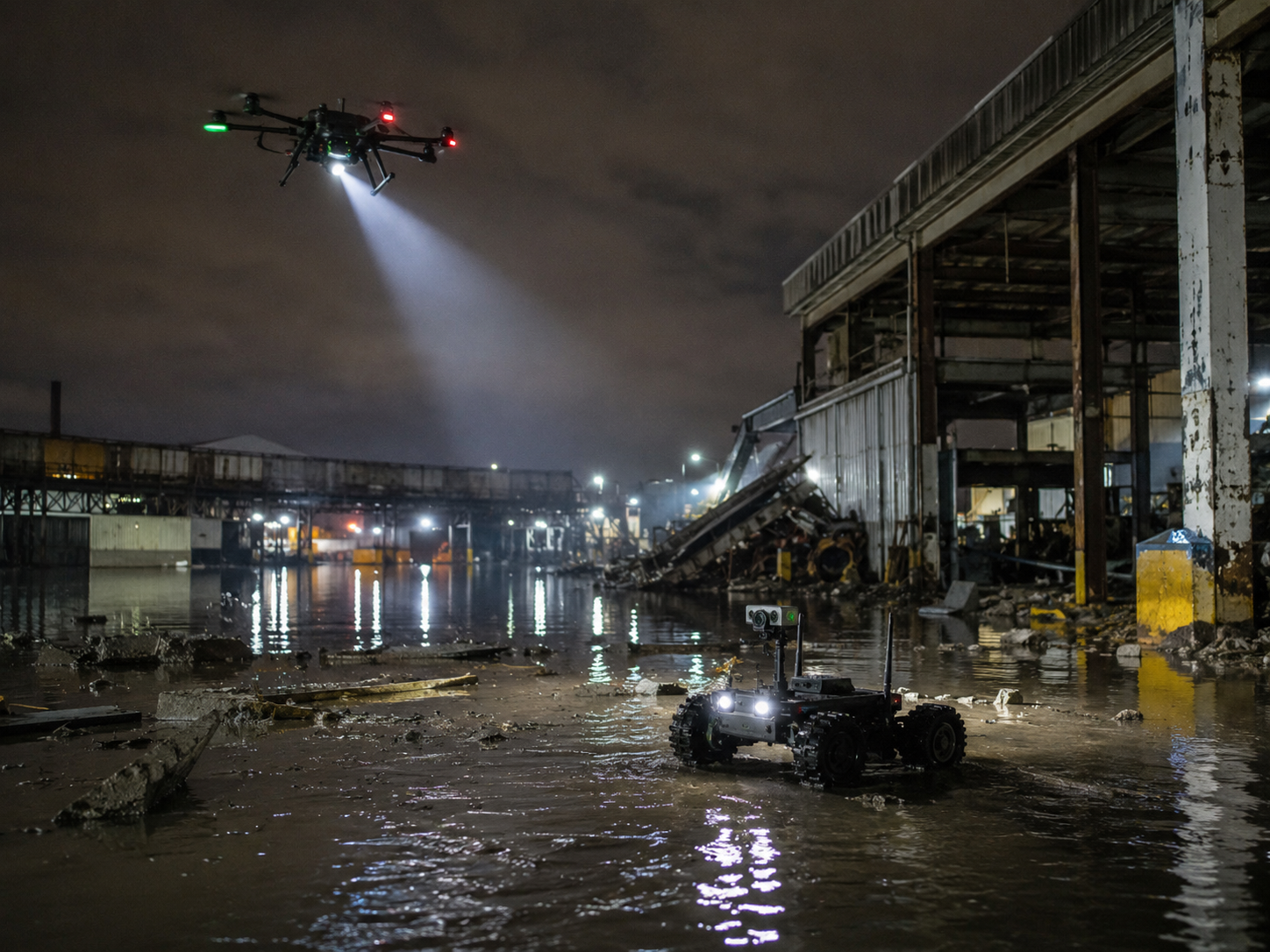
A multi-agent search operation is moving through a flood-damaged industrial site at night. One aerial unit sees heat signatures through broken roof panels. A ground robot reports blocked access from the east corridor. Another unit loses localization for 12 seconds near a metal structure. The command view is incomplete, delayed, and partly wrong.
The mission cannot pause until the data is clean.
This is the real operating environment for Physical AI.
Autonomous systems do not make decisions with perfect information. They act through sensor noise, stale updates, uncertain terrain, changing weather, partial maps, and delayed communication. The challenge is not removing uncertainty. The challenge is reasoning through it.
That is the core of reliable AI for real-world operations: knowing what to do when the system cannot know everything.
NASA’s technical reporting on autonomy states that autonomy involves making decisions and taking actions in the presence of uncertainty. It also notes that validating autonomy means checking whether systems make intelligent decisions even when observed conditions differ from expected conditions.
For operators, developers, and embedded teams, that definition matters. Autonomy is not a perfect prediction. It is controlled decision-making under imperfect knowledge.
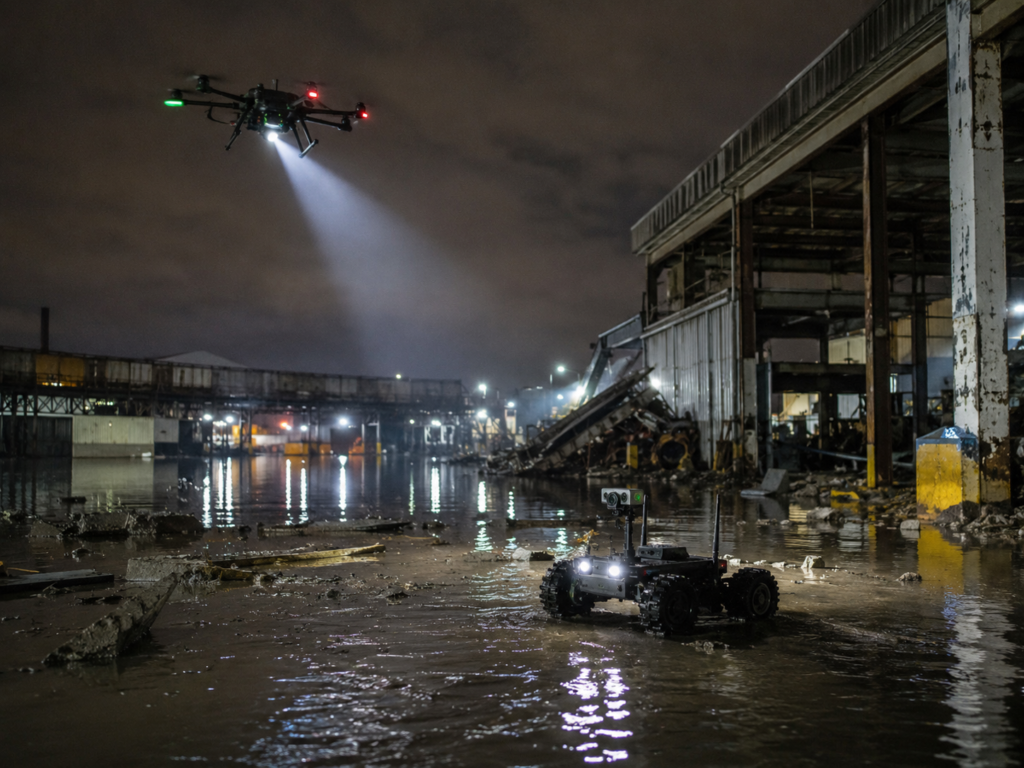
Autonomous drone and ground robot operating in a flood-damaged industrial site at night
Uncertainty Is Not an Edge Case
In cloud software, uncertainty is often treated as a data-quality issue. Clean the data. Refresh the dashboard. Re-run the query.
Physical systems do not have that luxury.
A drone may see a vehicle-shaped object through smoke. A rover may infer terrain strength from partial sensor readings. An autonomous aircraft may need to continue safe corridor behavior while a ground link is delayed. A satellite may process observations before downlinking them later.
Uncertainty is not rare. It is normal.
That means autonomous systems software has to explicitly represent uncertainty. A system should not simply ask, “What is happening?” It should ask, “How confident am I, what could be wrong, and what action remains safe if my current belief is incomplete?”
That shift is what separates brittle automation from agentic AI.
From Prediction to Belief
A prediction gives the system an answer.
A belief gives the system a working model of what may be true.
In real-world autonomy, belief is more useful than certainty because certainty is often unavailable. Physical AI needs to update its understanding as new observations arrive, old assumptions expire, and other members of the mission community report delayed information.
For example, if a robot detects a possible obstruction, it should not treat that detection as absolute truth. It should weigh confidence, context, mission priority, energy state, and the cost of being wrong.
A good autonomy layer asks:
- Is this observation reliable?
- Is it recent enough to matter?
- What are the risks if it is wrong?
- What action preserves the safest options?
- Should this unit act locally or wait for coordination?
This is where edge AI decision-making becomes more than local inference. The system is not just classifying inputs. It is managing belief, risk, and action.
Why “More Data” Is Not Always the Answer
The common instinct is to solve uncertainty with more data.
In physical operations, more data can create new problems.
More sensing consumes power. More processing creates heat. More transmission uses bandwidth. More data can also arrive too late to help the current decision.
A multi-agent team operating off-grid may need to decide which data is worth collecting, which data should be compressed, and which data should be ignored. Delayed information may still be useful for mission-level orchestration, but not for immediate collision avoidance or path planning.
This is why AI software for autonomy cannot be designed as a constant data pipeline. It has to be selective.
The question becomes: what information changes the decision?
If a data point does not change the action, it may not be worth the energy, compute, or bandwidth required to collect and share it.
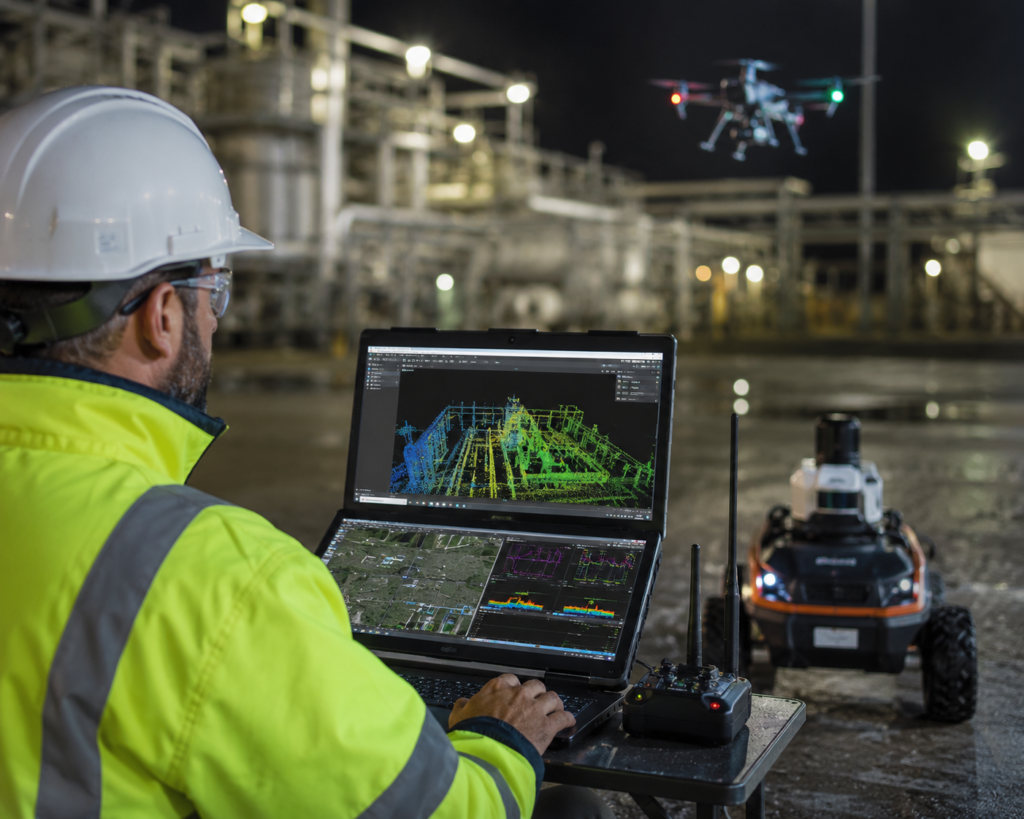
Engineer reviewing autonomous system sensor data and mission telemetry in the field
Risk-Sensitive Decisions Matter
Uncertainty is not only about what the system sees. It is also about what could happen next.
NASA has supported research into risk-sensitive learning and decision-making for autonomous space robots, including systems that operate in unknown and uncertain environments without continuous control or supervision. The work combines Bayesian learning with risk-sensitive decision-making, enabling autonomous systems to adapt online while adjusting conservatism in response to uncertainty.
That is the right frame for mission-critical AI.
A system should not behave the same way when confidence is high and when confidence is low. It should become more conservative when uncertainty increases, especially in safety-critical conditions.
In practice, that may mean:
- Slowing movement when localization confidence drops
- Choosing a safer path when terrain classification is uncertain
- Holding a task until another unit confirms an observation
- Reducing autonomy scope when sensor quality degrades
- Preserving power for recovery when mission state becomes unclear
Reliable AI systems are not aggressive by default. They are adaptive by design.
The Multi-Agent Problem: Shared Uncertainty
One autonomous system has local uncertainty.
A mission community has shared uncertainty.
When multiple robots, drones, vehicles, or field systems operate together, each unit sees only part of the world. One unit may have fresh local data. Another may be stale but important context. A third may be offline and rejoin later.
Distributed AI systems need to reconcile these partial views without assuming one perfect source of truth.
That requires coordinated autonomy built around:
- Time-stamped observations
- Confidence levels
- Local decision rights
- Delayed synchronization
- Conflict resolution
- Mission-level priorities
The goal is not to make every unit know everything. The goal is to make sure each unit knows enough to act safely and contribute to the mission.
DARPA’s Assured Autonomy program described autonomous systems as operating in complex and unpredictable environments, while noting that higher levels of autonomy in uncertain, unstructured, and dynamic environments create major systems engineering challenges.
That is exactly where mission-level reasoning becomes necessary.
A Practical Rubric for Reasoning Under Uncertainty
Before deploying autonomy into a real operation, operators and developers should ask five questions:
1. What Does The System Believe, And How Confident Is It?
Confidence should be visible to the decision layer, not buried inside a model output.
2. What Happens When Observations Disagree?
The system needs rules to resolve conflicts among sensors, units, and delayed reports.
3. Which Decisions Can Be Made Locally?
Not every action should wait for centralized approval, especially when communication is intermittent.
4. When Should Uncertainty Trigger Caution?
Low confidence should change behavior, not simply appear in a log file.
5. What Information Is Worth Spending Energy To Collect?
In Physical AI, sensing, computing, and communication all have operational costs.
If a system cannot answer these questions, it is not ready for serious autonomous operations at scale.
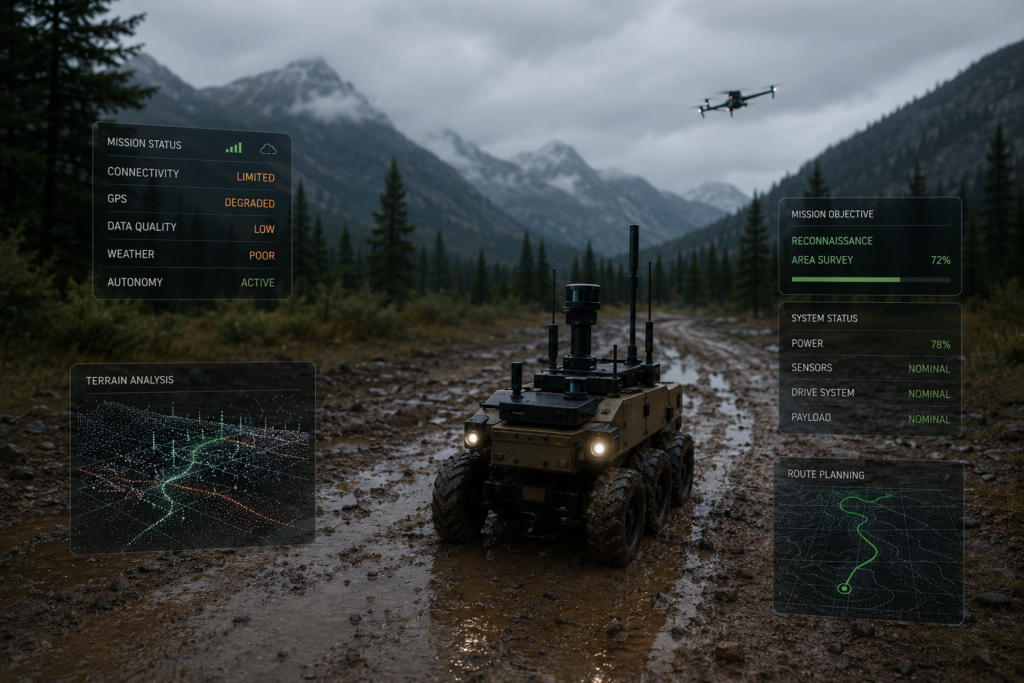
An autonomous system operating in a remote environment without perfect data or connectivity
What Comes Next: Autonomy That Knows What It Does Not Know
The next stage of Physical AI is not just better perception. It is better judgment under constraint.
Autonomous systems need to understand their own uncertainty, health, power state, communication status, and role within the mission community. They need to coordinate under silence, update beliefs as delayed information arrives, and adjust behavior based on risk.
That is where agentic AI becomes operationally meaningful.
It is not just AI that acts. It is AI that reasons about what it knows, what it does not know, and which actions remain safe anyway.
Perfect Data Is the Wrong Goal
The future of autonomous systems software will not be built around perfect data. It will be built around disciplined uncertainty.
Operators do not need systems that wait for complete information. They need systems that can move forward carefully, locally, and intelligently when the world is incomplete.
That is the design shift.
AI autonomy platforms must stop treating uncertainty as an exception and start treating it as the norm in real-world operations. Physical AI must be able to maintain beliefs, weigh risk, coordinate partial knowledge, and adapt decisions without waiting for perfect visibility.
AstraQua Inc builds agentic Physical AI for coordinated autonomy in real-world environments where data is incomplete, connectivity is unreliable, and decisions must still be made.
Learn more about AI software for autonomy at www.astraqua.com.