
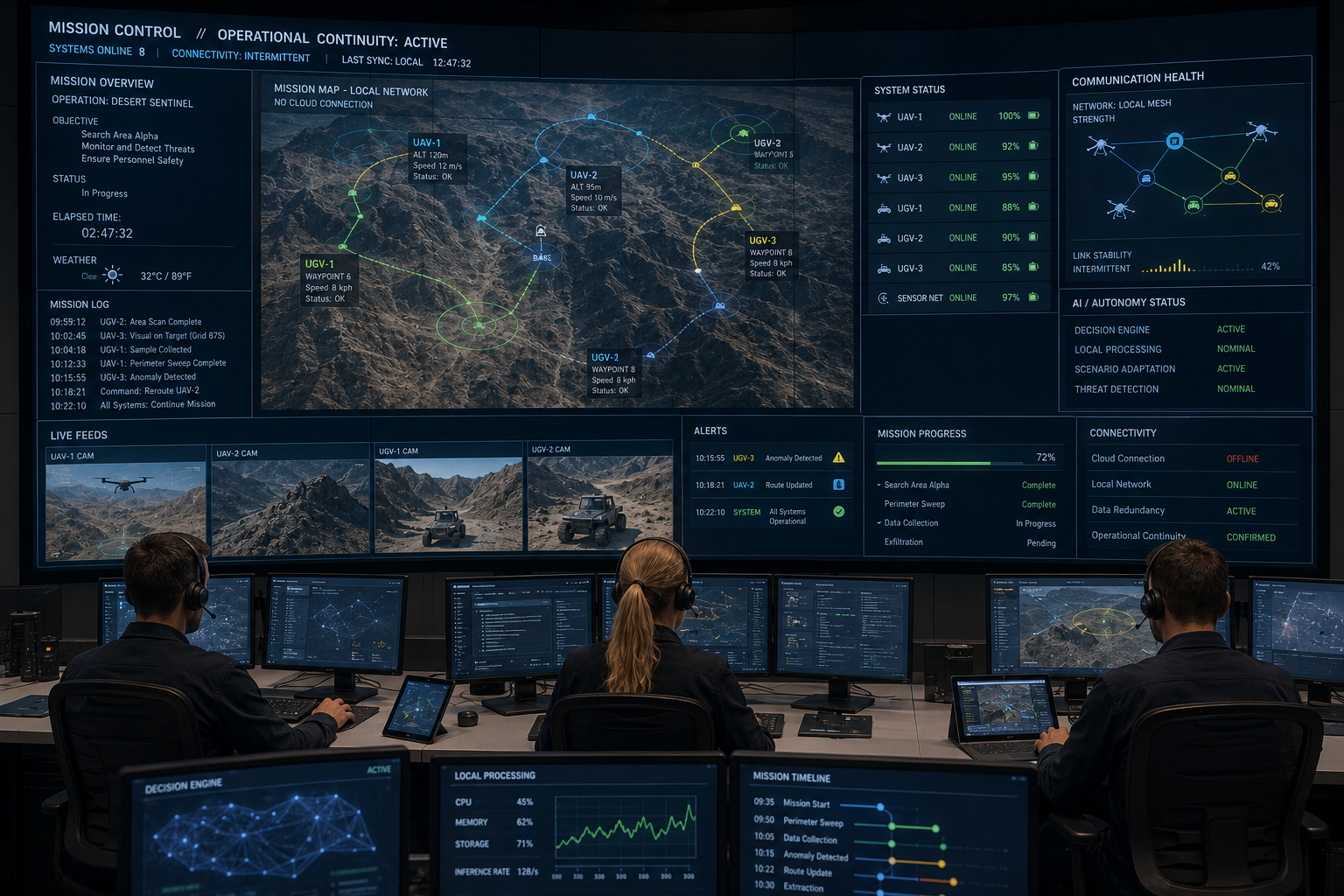
An advanced air mobility aircraft is moving through a controlled corridor when its ground link drops mid-route. The weather is changing. Nearby traffic is still moving. The onboard system has seconds to decide whether to continue, hold, reroute, or enter a safety procedure.
There is no time to wait for the cloud.
This is the core test of real-world autonomy: what happens when connectivity goes to zero?
For robots, drones, satellites, industrial systems, and autonomous vehicles, disconnection is not an edge case. It is an operating condition. Links degrade. Data arrives late. Bandwidth narrows. Ground systems fall behind the physical world.
Autonomy that freezes when connectivity drops is not autonomy. It is a remote operation with better branding.
AstraQua’s view is that direct AI for real-world operations must be able to preserve mission intent, make bounded decisions, and coordinate locally even when external communication is delayed or unavailable.
Zero Connectivity Is Not a Failure Mode
Most connected systems treat lost communication as a fault. In physical operations, that assumption is too fragile.
A satellite may only have short ground-contact windows. A drone may enter a radio-shadowed area. A robot may move inside a facility where signals are blocked. A vehicle may receive instructions with delays while still needing to make safety-critical decisions.
NASA has described distributed spacecraft autonomy as important because satellites operating around the Moon, Mars, or other distant areas can face communication delays that limit mission efficiency. That same principle applies across many autonomous systems: the farther intelligence is from the physical action, the more brittle the mission becomes.
Zero connectivity should not mean zero capability.
The system still needs to understand:
- What mission is it executing
- What constraints must it respect
- What risks are increasing
- What decisions are allowed to be made locally
- What information must be saved for later synchronization
This requires a different design philosophy. Connectivity becomes helpful, but not foundational.
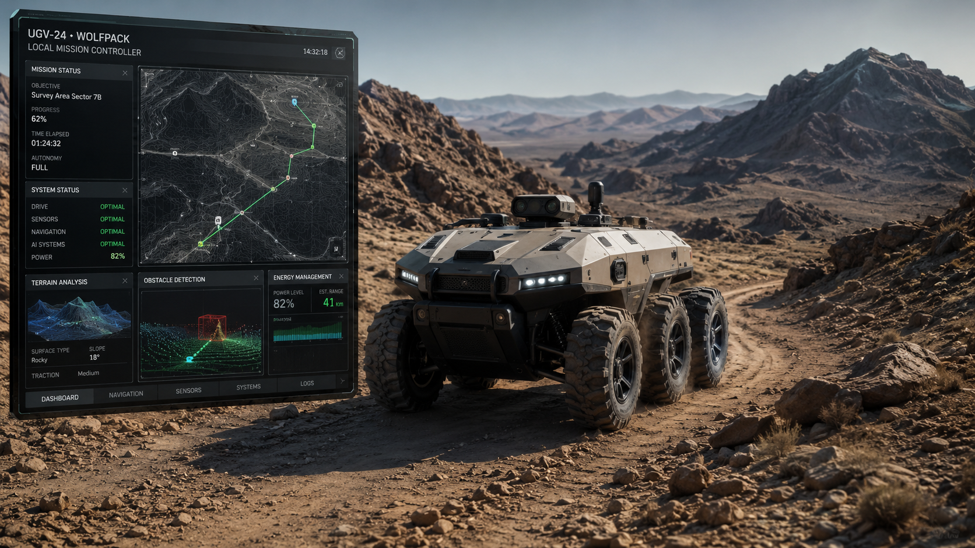
Autonomous vehicle operating with onboard AI in a remote environment.
The Real Problem Is Stale Control
When a link drops, the most obvious problem is silence. The deeper problem is time.
A cloud system may eventually receive data, but by then the physical situation may have changed. A path may no longer be safe. A battery state may have shifted. A target may have moved. A teammate may have already taken action.
Delayed data is not useless, but it cannot be treated as current.
This is where autonomous systems software needs temporal awareness. It must reason about what information is fresh, what is stale, and what should still influence decisions.
For example, a coordinated autonomy system operating in a search area may receive a delayed hazard update from one unit after another has already entered a nearby zone. The system needs to reconcile that update without causing confusion or duplicate action.
That is not just a communication problem. It is a reasoning problem.
What Must Work at Zero?
Before deploying off-grid autonomy, operators and embedded teams should ask a simple question: what must still work when nothing external can respond?
A practical zero-connectivity checklist includes five requirements.
1. Mission Intent Must Persist
The system should not need continuous instructions to understand the objective. It should know whether it is inspecting, searching, monitoring, avoiding, returning, or holding.
2. Local Safety Decisions Must Continue
Collision avoidance, energy preservation, hazard response, and safe fallback behavior cannot wait for remote approval.
3. Compute Must Adapt To The Operating State
A low-power system should reduce nonessential inference, lower processing frequency, or shift to simpler decision policies when needed.
4. Delayed Data Must Be Handled Intelligently
When communication returns, the system should reconcile updates based on time, relevance, and mission impact.
5. Coordination Must Resume Without Confusion
A multi-agent team should be able to resynchronize after a period of silence without duplicating work, conflicting over roles, or overwriting useful local decisions.
If these five capabilities are missing, the system may be connected and automated, but it is not ready for zero-connectivity autonomy.
Reliability Is Local First
The NIST AI Risk Management Framework identifies reliability, safety, security, resilience, and robustness as characteristics of trustworthy AI systems. In physical autonomy, those qualities have to hold when infrastructure is degraded, not only when networks are stable.
That means reliability starts locally.
A robot should not stop reasoning because the network is unavailable. A satellite should not wait passively through a communication gap if onboard decisions can preserve mission value. A vehicle should not depend on remote systems for immediate safety behavior.
Local-first reliability does not mean removing human oversight or external control. It means designing autonomy so that the system can act within approved boundaries until oversight is restored.
This is the difference between uncontrolled independence and bounded autonomy.
The system must know what it can decide, what it cannot decide, and when it must choose the safest available action.
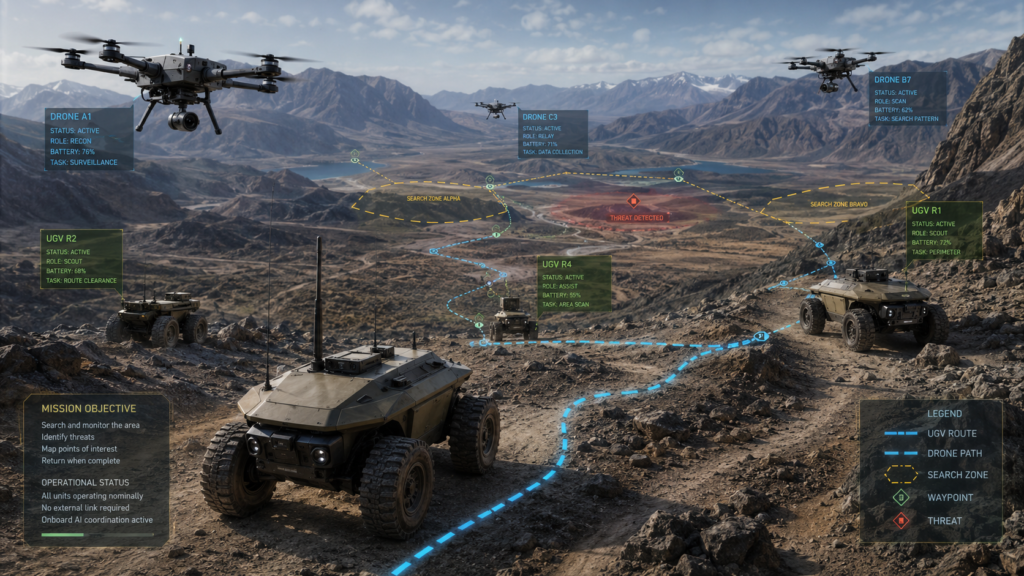
Multi-agent autonomous systems coordinating in a communications-denied mission.
Coordinated Autonomy Under Silence
Zero-connectivity operation becomes more complex when multiple systems are involved.
A single autonomous unit needs local reasoning. A mission community needs shared intent without constant shared state.
That means each unit must understand its role, current constraints, and decision boundaries. It also means the coordinated autonomy layer must tolerate incomplete information.
In practice, this may look like:
- Units continuing assigned coverage zones during silence
- Local systems prioritizing safety and mission preservation
- Mission updates are being stored until communication returns
- Roles are being renegotiated after delayed synchronization
- Higher-level orchestration adjusts once reliable data is available
The goal is not to make every system know everything at every moment. That is unrealistic in off-grid operations.
The goal is to make each system capable of maintaining mission coherence.
What Comes Next: From Offline Operation to Mission Intelligence
The next step is not simply a better offline mode.
It is mission-level intelligence.
That means autonomy systems that understand the health state, energy state, communication state, mission priority, and team role simultaneously. It means AI software that can choose when to compute, when to conserve, when to share, and when to wait.
For developers, this changes how AI autonomy platforms are evaluated. The question is no longer only whether the model performs well. The question is whether the system can reason under silence.
For operators, this creates a new standard: autonomy should keep the mission moving even when connectivity disappears.
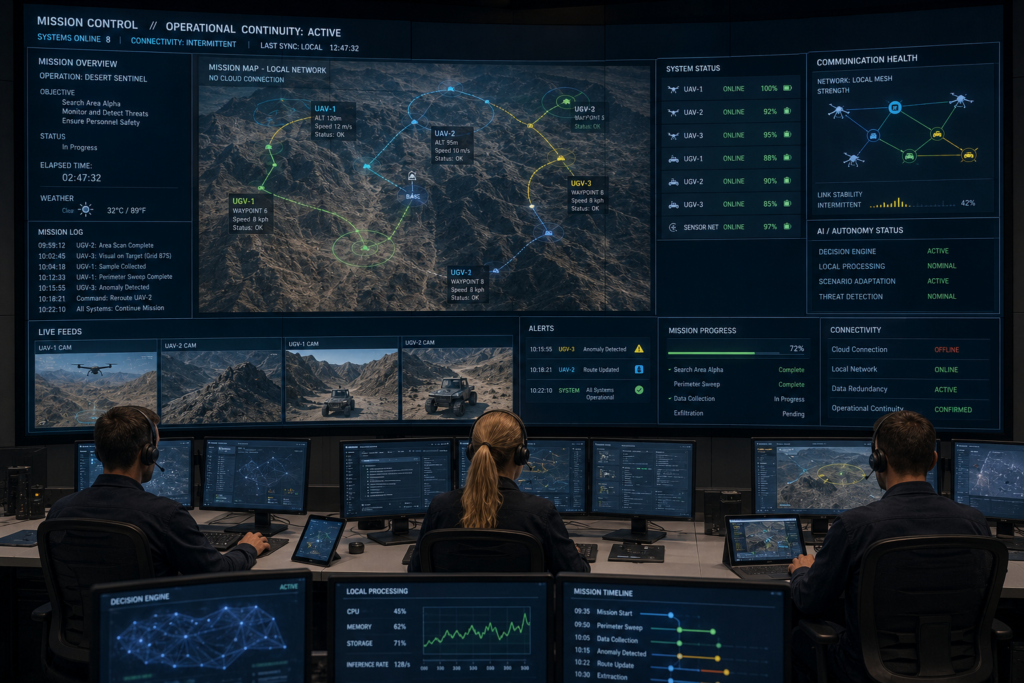
Mission control monitoring autonomous operations during intermittent connectivity.
The AstraQua View
AstraQua Inc builds agentic Physical AI for autonomous systems that need to decide, coordinate, and operate together without relying on the cloud.
The important shift is operational. AI for drones, robotics systems, industrial autonomy, advanced air mobility, and government operations must stop treating zero connectivity as an exception.
It is part of the environment.
Agentic AI for physical systems must be power-aware, locally capable, and coordinated by design. It must preserve mission intent when communication drops and recover cleanly when communication returns.
Connectivity Should Extend Autonomy, Not Define It
The future of autonomy will not be built on the assumption that every system is always connected.
That assumption is too weak for the physical world.
What must change is the design center. AI software for autonomy has to be built for silence, delay, degraded links, and partial information from the beginning. Cloud systems can support the mission, but they cannot be the reason the mission continues.
Operating at zero means the system does not freeze, wait, or collapse when the link drops. It keeps reasoning within safe boundaries. It preserves intent. It coordinates when it can. It recovers when communication returns.
That is the standard real-world autonomy has to meet.
Learn more about power-aware, edge-first Physical AI from AstraQua.