
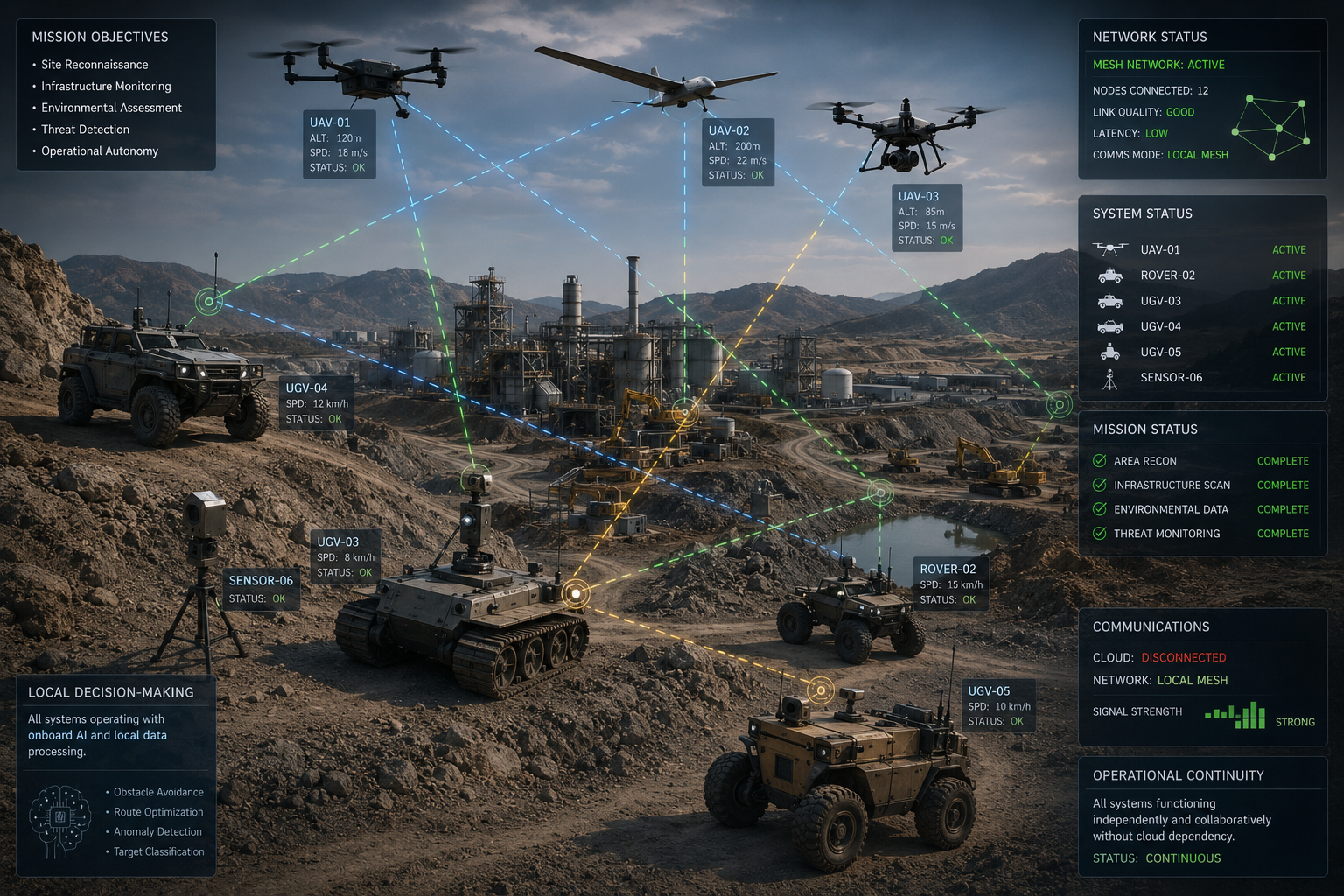
A reconnaissance drone begins a search mission in a remote mountain range. Suddenly, connectivity drops and headwinds drain battery reserves faster than anticipated. Despite these disruptions, the mission must continue.
This is where standard AI fails.
The failure isn’t algorithmic inaccuracy; it’s the inability of traditional AI to handle physical constraints like limited compute, thermal budgets, and intermittent connectivity. Physical systems cannot rely on unlimited cloud resources. In these environments, every decision consumes energy and every transmission costs battery life.
The missing layer is intent: the ability to translate mission objectives into adaptive tasks and efficient execution. Physical AI succeeds only when it understands not just what to do, but why it is doing it and how to achieve it with finite resources.
In Physical AI, energy—not just the algorithm—is the true bottleneck.
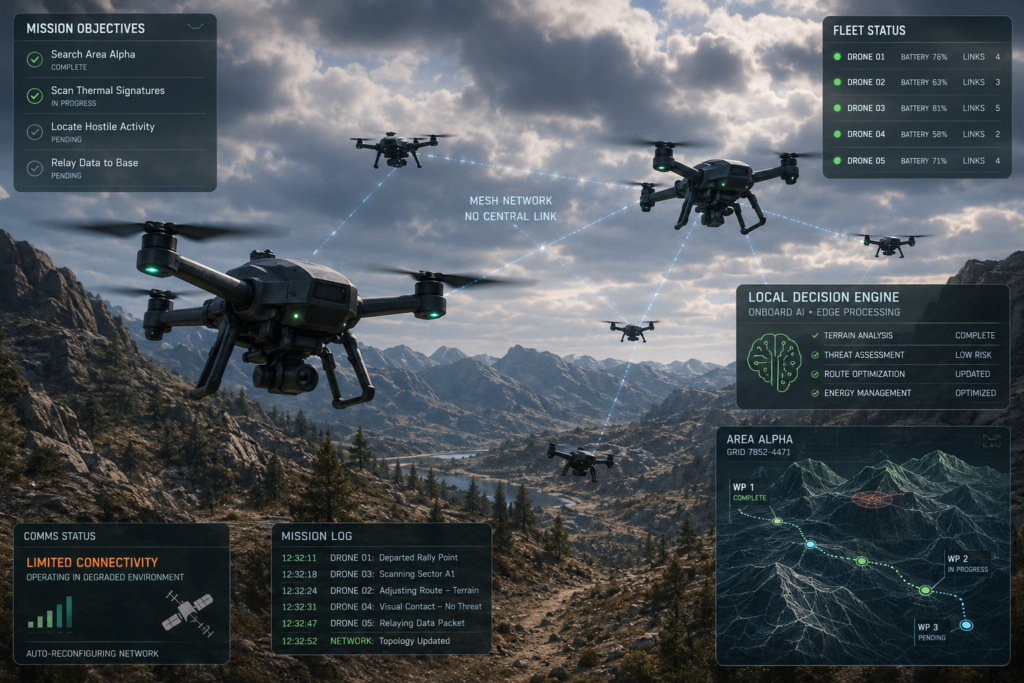
Autonomous fleet coordinating edge AI decisions during an off-grid mission.
Why Traditional AI Breaks in Physical Systems
Most modern AI thrives in data centers where electricity and cooling are abundant. Reasoning engines can scale via cloud infrastructure without regard for power consumption. Physical systems, however, operate under vastly different constraints.
Physical systems operate under very different conditions.
Autonomous fleets often function:
- On batteries with finite energy
- Using embedded processors with limited compute
- In harsh thermal environments
- With unreliable or denied communications
- Across large geographic areas where cloud connectivity is unavailable
In these conditions, cloud-dependency is a liability. Unnecessary computation reduces endurance, and every remote dependency creates a potential failure point. Success requires intelligence that is efficient, not just abundant.
Research from the International Energy Agency highlights the growing energy demands of AI computing infrastructure, emphasizing that computational workloads increasingly drive power consumption at scale. While cloud computing continues to expand rapidly, battery-powered edge systems cannot simply inherit the same computational assumptions.
For autonomous operations, efficient intelligence matters more than unlimited intelligence.
The Missing Layer: Intent
Most discussions about autonomy focus on perception, planning, or execution.
Yet something happens before any of those.
Every autonomous mission begins with intent.
Intent defines the desired outcome rather than prescribing rigid actions. Instead of micro-managing movements, operators define mission-level objectives.
Examples include:
- Monitor a designated area for four hours.
- Inspect critical infrastructure while minimizing energy use.
- Search for anomalies and coordinate with nearby assets.
- Continue operating despite communication loss.
Intent creates flexibility.
This enables systems to respond intelligently when reality diverges from the flight plan, adjusting tasks dynamically while remaining committed to the primary goal.
This enables systems to respond intelligently when reality diverges from the original plan.
From Intent to Tasks to Execution
The relationship between intent, tasks, and execution forms the operational foundation of resilient autonomy.
Intent defines what success looks like.
Tasks determine how that objective should be achieved.
Execution carries out these tasks, adapting to local conditions to ensure the mission remains productive rather than simply following outdated instructions.
When conditions evolve, the mission intent remains stable even as individual tasks change.
For example, if one autonomous asset loses power, nearby systems can redistribute responsibilities without requiring a human operator to redesign the mission.
If weather conditions change, execution adapts while preserving the original operational objective.
This layered approach allows autonomous systems to remain productive rather than simply following outdated instructions.
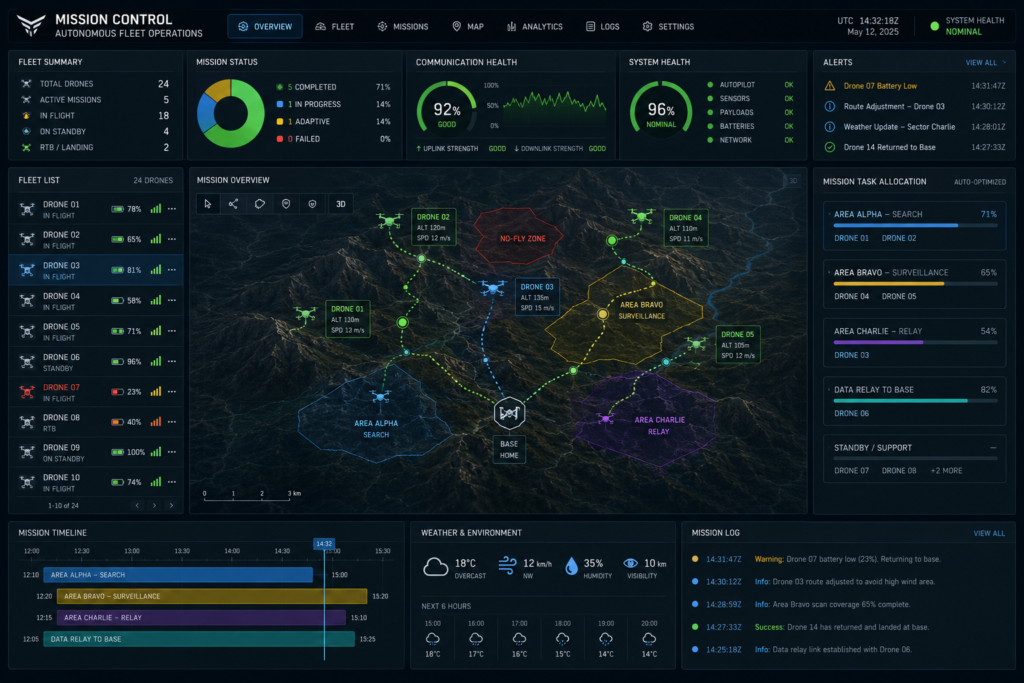
Fleet-level AI software coordinating adaptive mission execution across distributed autonomous systems.
Why Energy Becomes the Primary Constraint
In cloud AI, scaling often means adding more GPUs.
In Physical AI, scaling usually means extending operational time.
Every onboard calculation competes for power with propulsion and sensing. Consequently, compute is an energy allocation problem.
Compute, therefore, becomes an energy allocation problem.
Studies from MIT have repeatedly shown that AI inference efficiency depends heavily on optimizing computation close to where data is generated rather than relying exclusively on centralized processing. Edge inference reduces communication overhead while lowering latency and energy costs for many real-world applications.
This changes how autonomous software should operate.
Instead of maximizing computational complexity, Physical AI prioritizes:
- Local decision-making
- Efficient inference
- Minimal communication
- Adaptive task allocation
- Intelligent resource management
Energy-aware autonomy extends mission duration while improving operational resilience.
Fleet Autonomy Is More Than Independent Devices
Individual autonomous systems are valuable.
Coordinated autonomous fleets are transformational.
Fleet-scale autonomy requires software that coordinates multiple agents toward a shared objective. This means redistributing workloads when a system fails and sharing only essential data to preserve bandwidth and power.
This means:
- Redistributing work when one system becomes unavailable.
- Sharing only essential information rather than every sensor reading.
- Prioritizing mission objectives over individual behaviors.
- Continuing operations despite degraded communications.
Distributed intelligence allows every system to contribute to the larger mission without relying on constant centralized control.
Research published by National Institute of Standards and Technology has emphasized that resilient autonomous systems benefit from distributed architectures that reduce single points of failure while improving reliability in mission-critical environments.
This is particularly important for government operations, industrial inspection, advanced air mobility, and remote infrastructure monitoring where operational continuity matters more than perfect connectivity.
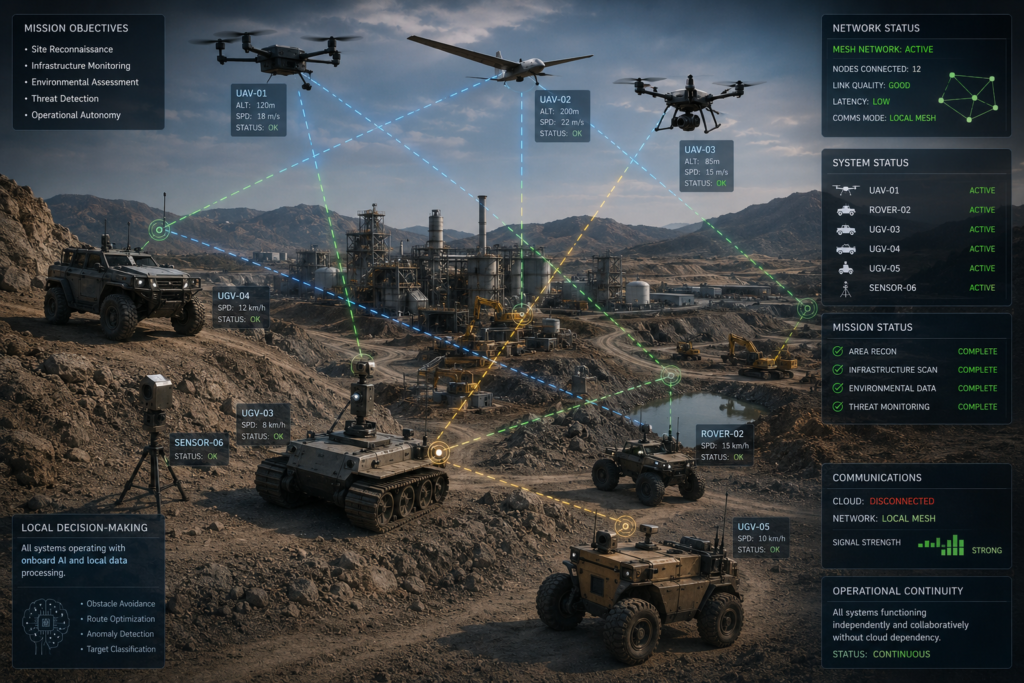
Distributed Physical AI enabling resilient fleet-scale autonomous operations.
Edge-First Intelligence Changes Operational Thinking
Cloud AI assumes connectivity.
Physical AI assumes uncertainty.
Instead of asking where the largest model can run, operators increasingly ask:
- Can the mission continue without connectivity?
- Can decisions remain reliable with limited compute?
- Can energy usage support longer deployments?
- Can fleets adapt without human intervention?
These questions shift the focus from model performance to operational performance. Reliable AI is measured not by benchmark accuracy, but by mission completion.
Reliable AI is not measured solely by benchmark accuracy.
It is measured by mission completion.
The Future of Autonomy Starts Above the Algorithm
Autonomy is often described as machines making decisions independently.
But real-world operations require something more fundamental.
They require systems that understand mission intent, generate adaptive tasks, and execute intelligently within strict energy, compute, and communication limits.
That missing layer transforms isolated AI models into resilient Physical AI capable of operating where infrastructure cannot be assumed.
As autonomous operations continue expanding across robotics, advanced air mobility, industrial infrastructure, and government missions, success will depend less on building larger models and more on building systems that think efficiently.
The future of autonomy will belong to platforms that are power-aware, edge-first, and resilient by designnot because they have access to unlimited intelligence, but because they know how to achieve the right mission with the resources available.
From Smarter AI to Smarter Autonomy
Physical autonomy is no longer defined by how much AI a system can run. It is defined by how effectively intelligence supports real-world missions under real-world constraints. By connecting intent, tasks, and execution, organizations can build autonomous operations that remain reliable, adaptive, and efficient even when power, connectivity, and compute are limited.
At AstraQua Inc., this edge-first perspective shapes how Physical AI enables resilient, coordinated autonomy for mission-critical operations. Explore how www.astraqua.com is advancing the next generation of autonomous systems designed for the realities of the physical world.