

Distributed autonomous fleet using off-grid Physical AI for coordinated, energy-efficient edge decision-making
A field robot is inspecting a remote pipeline when its battery drops faster than expected. The terrain is uneven. The onboard processor is running hot. Sensor data is piling up faster than it can be analyzed. A satellite link is available, but delayed. Sending every frame to the cloud would waste power, add latency, and risk leaving the robot unable to complete the mission.
The failure is not that the AI model is “not smart enough.”
The failure is energy.
For physical systems like robots, drones, autonomous vehicles, satellites, and industrial field equipment, AI breaks when software assumes unlimited compute, stable power, constant cooling, and instant connectivity. In the real world, those assumptions rarely hold.
The core argument is simple: AI fails in physical operations because energy, not algorithms, is the primary constraint.
Connectivity matters, but it is secondary. A system that cannot manage power, heat, compute load, and delayed data will fail even when a network is available.
That is why off-grid AI requires a fundamentally different design philosophy. It is not cloud AI moved closer to the device. It is power-aware, edge-first autonomy designed for physical limits from the start.
Why Energy Comes Before Connectivity
Most AI systems are designed around abundant infrastructure. Data centers have dedicated power, cooling, storage, and high-performance compute.
The International Energy Agency estimated that data centers consumed about 415 TWh of electricity in 2024, around 1.5% of global electricity consumption. That scale is useful for training and heavy cloud workloads, but it is a poor design model for machines operating in the field.
A drone, robot, vehicle, or satellite does not get to borrow that energy model.
It has a finite battery, limited thermal headroom, and competing power demands. Propulsion, sensing, communication, onboard compute, navigation, and safety systems all draw from the same constrained energy budget.
This changes the engineering question.
The question is not, “Can the model make the right decision?”
The question is, “Can the system make the right decision at the right time, using the available power, without compromising the mission?”
That is the real off-grid AI problem.
Physical AI Has Physical Failure Modes
Physical AI operates inside systems where software decisions affect movement, timing, safety, and mission continuity.
A cloud application can retry a request. A robot with low battery power cannot retry the same hill climb indefinitely. A satellite cannot assume continuous ground contact. A drone cannot spend unlimited power processing high-resolution video while also fighting wind.
NASA describes the electrical power system as a fundamental spacecraft subsystem responsible for power generation, storage, distribution, and management, often taking up a significant share of spacecraft volume and mass. That is a useful reminder for every Physical AI system: energy is not an implementation detail. It is mission architecture.
In real deployments, AI software must account for:
- Limited power budgets
- Heat buildup from onboard compute
- Intermittent operation during low-energy states
- Delayed or incomplete data
- Short windows for communication
- Tradeoffs between sensing, inference, movement, and coordination
This is where generic AI commentary becomes useless. The mission does not care how impressive a model looked in a benchmark. It cares whether the system can keep operating under constraint.
Off-Grid AI Is Not Incremental Optimization
Many teams treat off-grid AI as a performance-tuning exercise.
Compress the model. Reduce latency. Run inference locally. Add fallback logic.
Those steps help, but they are not enough.
Off-grid AI requires a different design philosophy because the system must be built around constraint, not abundance. Power, compute, memory, thermal load, and communication must shape the design of intelligence.
That means AI autonomy platforms need to support:
- Event-triggered inference instead of constant processing
- Adaptive model selection based on mission phase
- Local decision-making when communication is delayed
- Fleet coordination that tolerates stale data
- Reinforcement learning policies that account for resource use
- Mission logic that degrades safely instead of stopping abruptly
Research on low-power UAV autonomy notes that limited payload capacity and available energy make it difficult to integrate onboard machine learning and vehicle control in small aerial systems. That challenge is not unique to drones. It shows up across robotics, satellites, industrial autonomy, and advanced air mobility.
The design shift is from “run AI on the device” to “make intelligence aware of the device’s operating reality.”
The Compute Tradeoff Operators Actually Face
In real-world operations, every inference has a cost.
A vision model may improve detection quality, but it can increase processor load. More processor load can increase heat. More heat may trigger throttling. Throttling can slow decisions. Slower decisions can reduce safety margins.
This is why on-device AI needs more than efficient models. It needs decision policies that understand when to compute, when to wait, when to simplify, and when to preserve energy for the next mission step.
For example, an autonomous inspection fleet may not need every unit running high-frequency analysis at all times. Some systems may process only anomalies. Others may switch to low-power monitoring until a trigger event occurs.
A vehicle may delay noncritical analysis until it reaches a charging window. A satellite may prioritize onboard filtering before downlink because communication is delayed and bandwidth is limited. This is what edge AI decision-making means in physical operations. Intelligence must be selective.

Distributed autonomous fleet using off-grid Physical AI for coordinated, energy-efficient edge decision-making
Fleet Autonomy Changes the Problem Again
One autonomous system has an energy problem.
A fleet has an energy, coordination, and timing problem.
Autonomous fleet management cannot rely on one central brain continuously directing every device. That creates a single point of failure and assumes the availability of communication that field operations often cannot guarantee.
Fleet-scale autonomy needs distributed AI systems. Each unit must be able to make local decisions, coordinate when possible, and continue mission execution when shared data is delayed.
That requires AI software for autonomy that supports:
- Local awareness
- Shared intent
- Resource-aware task allocation
- Delayed synchronization
- Conflict resolution between units
- Mission updates without constant cloud dependence
This is where collective intelligence AI becomes practical rather than abstract. The value is not that every device knows everything. The value is that each unit knows enough to act safely and contribute to the mission.
Reliability Is the Real Benchmark
For mission-critical AI, the benchmark is not model size.
It is uptime, predictability, recovery, and safe behavior under constraint.
The NIST AI Risk Management Framework identifies reliability, robustness, safety, security, and resilience as important characteristics of trustworthy AI systems. In physical operations, those qualities must be engineered into how autonomy behaves when power drops, data is delayed, or conditions shift.
Reliable AI systems do not assume perfect conditions. They plan for degraded ones.
That means off-grid AI must answer practical questions:
- Can the system continue to operate with partial data?
- Can it reduce the compute load before overheating?
- Can it preserve energy for recovery?
- Can it coordinate with the fleet after delayed communication?
- Can it make bounded decisions without waiting for the cloud?
For operators, these questions matter more than abstract model performance.
The AstraQua View: Autonomy Must Become Power-Aware
AstraQua Inc builds agentic Physical AI for autonomous fleets that need to decide, coordinate, and operate without relying on the cloud.
The important shift is not product-led. It is operational.
AI for real-world operations must stop treating energy as a hardware issue and start treating it as a software design constraint. Developers and embedded teams building AI for drones, robotics systems, industrial autonomy, advanced air mobility, and government operations need autonomy software that accounts for limited resources from the outset.
The future of Physical AI will not be won by systems that assume more compute will always be available.
It will be won by systems that know when not to compute.
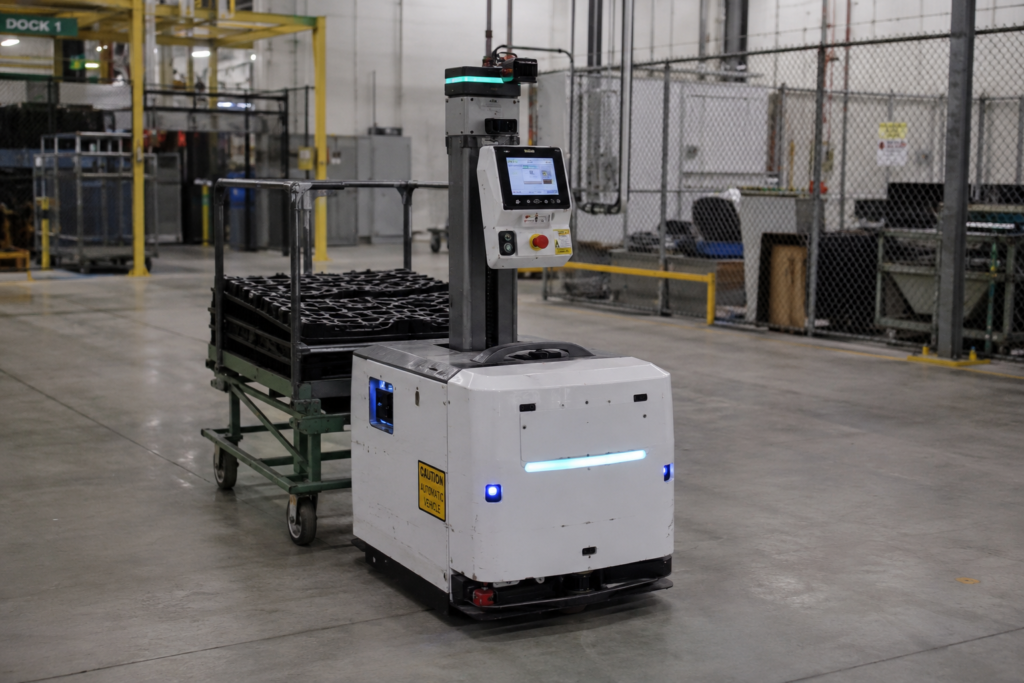
Battery-powered industrial autonomous system running low-power on-device AI without cloud connectivity
Off-Grid AI Starts by Changing the Assumption
The industry has spent years asking how to make AI larger, faster, and more connected.
Physical systems require the opposite question: how do we make AI selective, local, energy-aware, and resilient when infrastructure is limited?
That is the change that has to happen.
Off-grid AI is not a backup mode for cloud AI. It is a new operating model for autonomous systems software. Connectivity becomes useful when available, but never required for basic intelligence. Compute becomes something to budget, not something to assume. Power becomes part of the decision loop rather than an afterthought.
For operators and developers building reliable AI systems at fleet scale, the next step is clear: design autonomy around the physical world first.
Learn more about power-aware, edge-first Physical AI at www.astraqua.com.